You did not fly halfway around the world to spend your first good morning haggling with a stranger over a thirty-kilometer ride.
Getting from Da Nang to Hoi An is one of the easiest transfers in central Vietnam, and it is also one of the easiest to overthink. I live in Da Nang, I make this run all the time, and this is the honest breakdown: what each option actually costs, how long it really takes, which one quietly protects your day, and which one is a trap dressed up as a bargain. By the end you will know exactly which ride to book and why.
Why a 30-Minute Ride Is Worth Getting Right
Da Nang and Hoi An sit about 30km apart, which is 30 to 45 minutes by car and closer to an hour or more by bus. That is the whole distance. So the money gap between your options is small, a few dollars either way. What is not small is your morning.
Here is the part almost no other guide has caught up to: on paper, these are now technically the same city. In 2025 the old Quang Nam province was folded into an expanded Da Nang, and Hoi An became a ward of it, per Vietnam’s provincial reorganization. On the ground, nothing about the drive changed, and the two places still feel like different worlds, one a wide modern beach city, the other a lantern-lit old trading port. If you are still deciding whether to base yourself in one and day-trip the other, I broke that down in Da Nang vs Hoi An.
Because the ride is short, the real question is not “what’s cheapest.” It is “what gets me there without wasting an hour or feeling like I got played.” So let me just tell you what I do.
The Move for Almost Everyone: Open Grab (or Xanh SM)
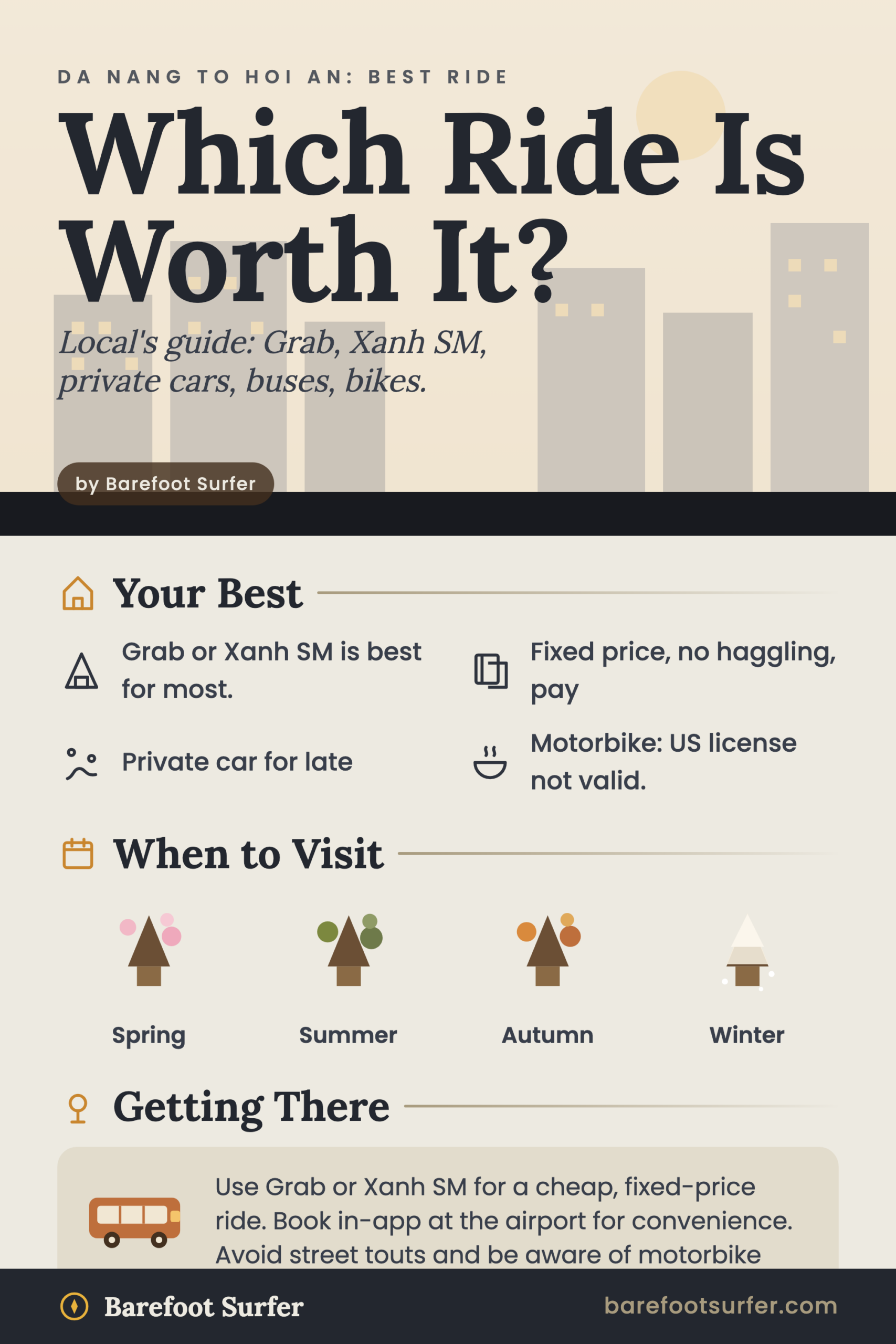
The best way to get from Da Nang to Hoi An is a ride-hailing car booked in the app, Grab or Xanh SM. It is cheap, the price is locked before you get in, there is no haggling, and you can pay cash. For the trip you are planning, this is the answer nine times out of ten.
I came in through Da Nang airport myself when I moved here, and it could not have been simpler. There is wifi at the airport, so you book your own ride right there, type in your hotel, and the app shows you the fare and the pickup point before you confirm. No card set up? Choose cash and hand the driver the money at the end. That is it. The cars are everywhere, so you are rarely waiting more than a few minutes.
How much does it cost? For scale, an app car from the airport to the beach side of Da Nang runs me about $3 to $4. Out to Hoi An is farther, so expect roughly 250,000 to 350,000 VND, around $10 to $14 for the car. Traveling as a couple or a group? Book the larger vehicle and split it, and it is still a rounding error on a trip like this. And honestly, this little ride is nicer with someone in the seat next to you anyway.

Grab vs Xanh SM: the local’s slightly cheaper pick
I use Xanh SM now, and almost every time it comes in a little cheaper than Grab on the same route. It is Vingroup’s all-electric fleet, and in 2025 it quietly overtook Grab as the biggest ride app in the country. The difference that matters to you: Xanh SM owns its cars and hires its drivers, so it runs like an actual taxi company. Clean, new electric cars, leather seats, quiet ride. Grab is whoever signs up to drive that day.
The one catch: Xanh SM really wants a Vietnamese phone number to register. So on day one, before you have a local eSIM sorted, just use Grab, which works fine on airport wifi with no local number. Once you are set up, price-check both and pocket the difference. Yes, both apps work in Da Nang and Hoi An, so you are covered on the way back too.
If you flag a street taxi instead, here’s how not to get clipped
The whole reason I push the app is that it deletes the part of this that goes wrong. No meter games, no “my meter’s broken,” no negotiating in a language you do not speak. But if you ever do wave one down, stick to the two metered brands locals trust, Mai Linh (green) and Vinasun, and make sure the meter is actually running.
The spot to keep your guard up is the airport. Men with official-looking badges will tell you the apps are down and offer a flat 500,000 to 700,000 VND for a ride the app does for a third of that. Smile, say no thank you, and walk to the pickup point the app gives you. You are not being rude, you are just not new.
When It’s Worth Upgrading to a Private Car
There is a time to skip the app and pre-book a car with a driver, and it is worth knowing exactly when:
- A late-night arrival, when you are wrecked and do not want to fiddle with an app.
- A pile of luggage or a group or family, where a set 7-seater is easier than juggling cars.
- When you want the driver to stop at Marble Mountains on the way, or wait while you explore and bring you back.
That is not most people. But if it is you, a fixed price and someone holding a sign at arrivals is money well spent. Agree the price and the route before you get in, and have your hotel arrange it or book a reputable transfer rather than trusting a tout at the curb. (If you are flying in first, here’s [getting through Da Nang airport without the usual mistakes][INTERNAL LINK PLACEHOLDER].)
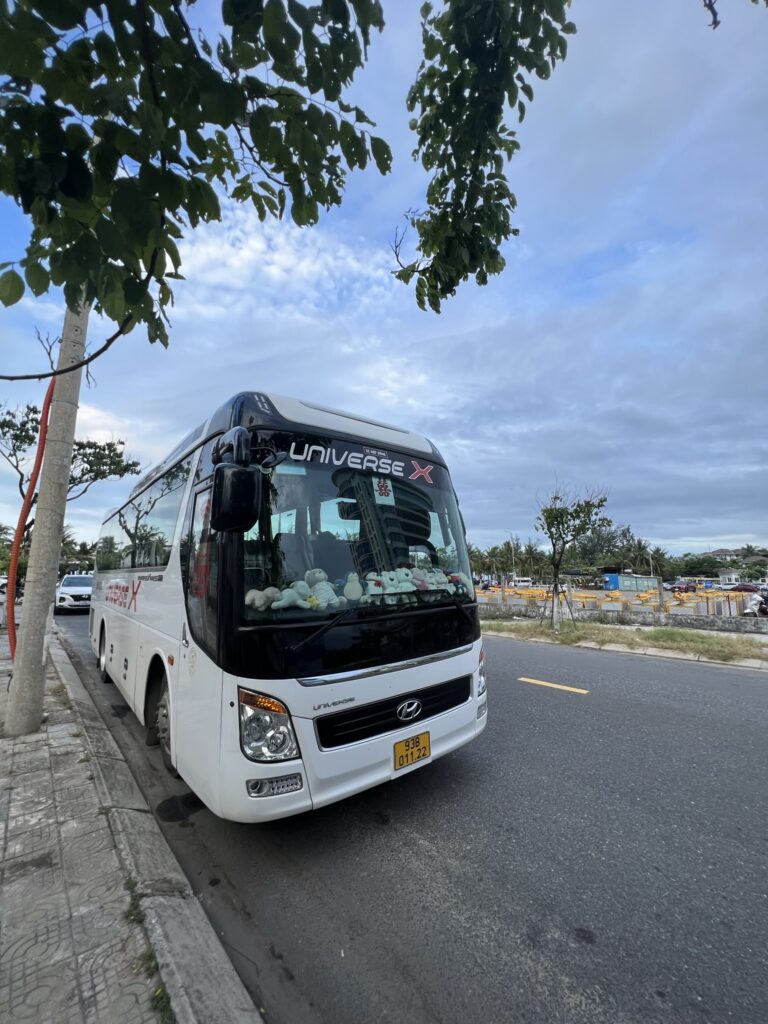
If you are landing late or traveling heavy and you just want to exhale, you can lock in a private transfer here [Booking.com / GetYourGuide affiliate link]. If not, save the money and open Grab when you walk out. Either way, you are covered.
The Motorbike Route: Be Honest With Yourself First
Three or four years ago, I would have told you to rent a bike and ride it yourself. I did exactly that. The coastal beach road down to Hoi An is a straight, easy, pretty run, and there is a quieter back road too if you want it. It was one of my favorite little rides in the area.
I am not going to tell you that now, and here is why.
Two things changed. First, since Decree 168 took effect in January 2025, enforcement got serious, and there are police checkpoints along this route now. Second, and this is the part nobody tells American travelers: your US license, even with a US international driving permit, is not valid to ride here. That is not my opinion, it is the US Embassy in Vietnam saying so directly. The US only issues the older 1949-style permit, and Vietnam only recognizes the 1968 one, which Americans cannot obtain as tourists.
Ride anyway and you are exposed to fines in the millions of dong, an impounded bike, and the real killer, your travel insurance voided the moment something goes wrong. That last one turns a bad afternoon into a five-figure medical bill. Make sure you actually understand what your travel insurance covers before you so much as sit on a scooter.
So for this trip, this once, I would not. If you are set on two wheels, ride behind a proper licensed driver instead. And whatever you ride, wear closed shoes, never sandals, which is a rule I do not bend, for reasons I get into in my shoe guide for this part of the world.
The Public Bus (LK-02): Cheapest, and Honestly Not Your Best Day
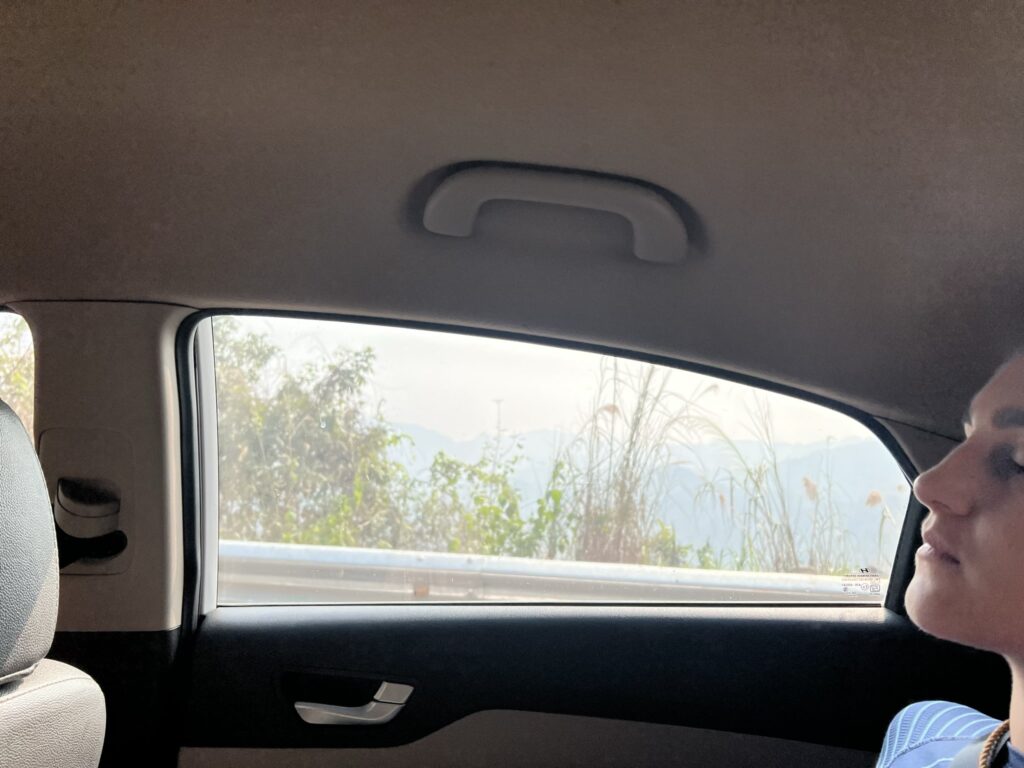
Yes, there is a public bus, and it is dirt cheap, about 30,000 VND, roughly a dollar. It is the LK-02 route run by FUTA, which is the old “yellow bus No. 1” under a new number.
Straight talk, because that is the whole point of this site: when I wanted to take this bus as a backpacker back in 2023, it was suspended after COVID, and I have not personally ridden this exact line since it came back renumbered. What I can tell you from plenty of other Vietnamese buses, including the run from Da Nang up to Hue, is that they work fine and the staff have been genuinely kind and helpful even when my Vietnamese ran out.
Here is the honest catch for you, though. The LK-02 takes the inland route, stops constantly, runs 60 to 90 minutes, and drops you at Hoi An’s bus station about 2km short of the Old Town, so you still need a short ride from there. Drivers are also known to quote foreigners more than the local fare, so keep small notes ready and know it should land around 30,000 VND.
Verdict: skip it, unless riding a local bus is a thing you actively want to do. The ten dollars you save is not worth the extra hour and the extra hassle on a trip this short and this precious.
The Verdict: What I’d Actually Book
For almost everyone, and definitely for the trip you are describing, the answer is the simplest one on the list: open Grab or Xanh SM, book the car, pay cash, go. It is cheap, it is metered, nobody is haggling with you, and you will not spend one minute of your morning feeling like a target. That is the whole game here, protecting the day, not shaving off a couple of dollars.
Upgrade to a pre-booked private car only if you are arriving late, loaded with luggage, or traveling as a group that wants to stop along the way. Take the bus only if the local-bus experience is the point for you. And the motorbike, as much as I loved it, is a no for this particular trip.
Then the ride is over almost before it starts, and you are stepping into Hoi An with the whole day still in front of you, which is exactly how it should be. When you get there, everything I love about the town is in my Hoi An writing, and if you want a day-by-day plan, [here’s how I’d spend three days in Hoi An][INTERNAL LINK PLACEHOLDER]. While you are still in Da Nang, this is what’s actually worth your time there, and the full Da Nang guide covers where to stay and eat.

Ready to make it effortless? Book your ride the easy way, whether that is opening Grab the second you land or [locking in a private transfer here][Booking.com / GetYourGuide affiliate link] for a late or heavy arrival. Either way, the hard part of your Da Nang to Hoi An trip is now the fact that there was no hard part.