The first time I rode a scooter in Vietnam I had no idea that the international permit I would have gotten back home wouldn’t have been worth the paper it was printed on here.
This is an honest answer to whether you should rent a motorbike in Da Nang. I live here and ride here every day, on my own bike, and I’ve rented from shops all over the country. Below is what the traffic actually does to you, what the law actually says about your license, what a bike genuinely opens up around Da Nang, and what I’d tell you to do instead if you’re spending two weeks in Vietnam and can’t afford to lose one of them.
Should You Even Think About a Motorbike in Da Nang?
I get the appeal because I live inside it. My bike is how I find everything worth finding here.
But I need to separate two things that get blended together in every article you’ve read. There is riding in the Vietnamese countryside, which is genuinely simple, and there is riding in a Vietnamese city, which is a skill. I’ve rented scooters all over Asia, and almost every time it was in rural places where there was no other way to move. That riding is easy. You point the bike and go.
Da Nang is not that. It isn’t Saigon or Hanoi either, but it’s multi-lane roads, constant roundabouts, and a lot of people, and it asks something of you that the countryside doesn’t. It took me about a week of full-time riding here before I felt genuinely set. A week. Not an afternoon.
So here’s the honest filter before we go any further. If you can watch how everyone else rides and copy it without needing it to make sense first, you’ll be fine. If you’re going to get angry that people ride differently than they do at home, don’t rent the bike. That’s not a personality judgment. It’s the actual variable.
The Real Deal on Safety (It’s Not Just About Helmets)
Is it safe to rent a motorbike in Da Nang? Not in the way you mean when you ask. Vietnam has 74 million motorcycles, more motorcycles than it has adults, and per WHO they make up more than 90% of the country’s vehicles and are involved in over 60% of road crashes. National figures put motorcycles in roughly 65 to 70 percent of all traffic accidents. You are not a special case on those roads. You’re the least protected thing on them.
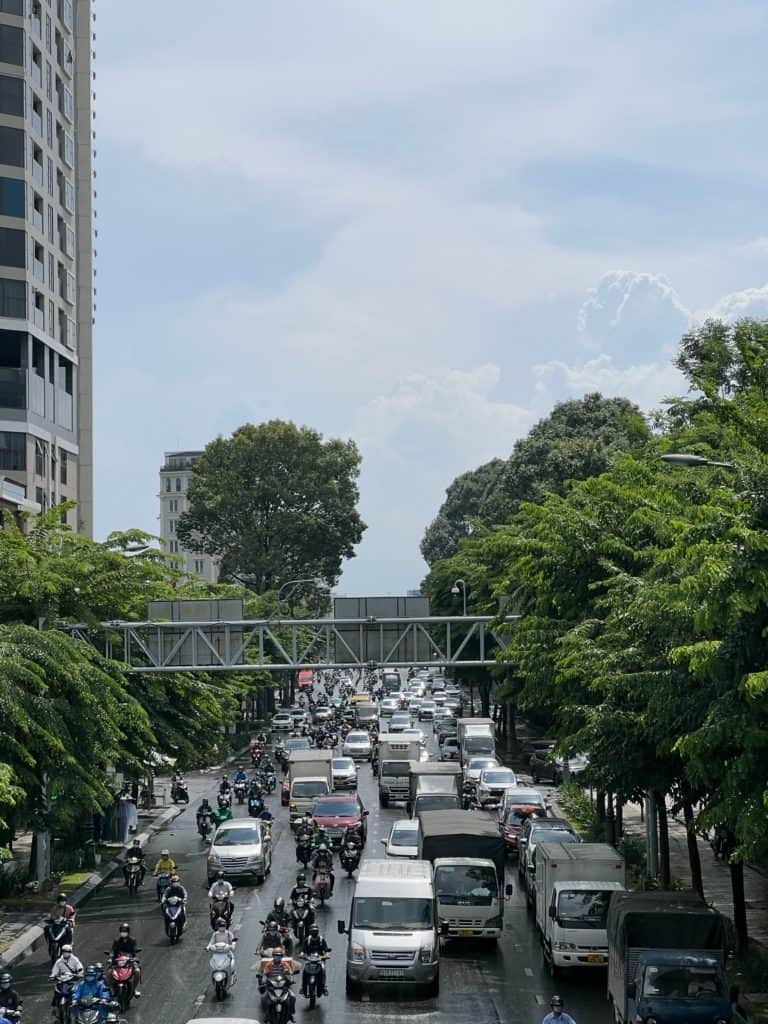
I’ve seen two bad ones here. The first was an intersection, a car turning across, and a woman on a scooter going straight who tried to make it at the last second. She got t-boned right off the bike. She walked away, which was luck. The car and the scooter both didn’t.
The second one still makes me ride wider. Highway, cars parked down the side of the road, a scooter rider tucked in close to them. A door opened. He went flying. The door dented.
The rest of what you see is smaller and constant. People dropping the bike mid-turn. Handlebars going sideways because somebody grabbed a fistful of front brake. And when I was in a Thai hospital getting rabies shots, half the waiting room was riders with gauze taped over their forearms and shins. That’s the version of this that doesn’t make the news. Not a fatality. Just a scraped-raw leg and two weeks of your trip spent healing in a hotel room instead of seeing the country.
You’ll Be Driving into a Different Road Culture
The single thing that took me longest to internalize: there is no right of way here. Not a soft one, not a loosely-followed one. It isn’t part of the system.
At home, two people arrive at a four-way and one of them has the right of way, so the other one stops. And if somebody doesn’t know the rule, you get that awkward shuffle of rules versus politeness. In Vietnam, both people just go at the same time and stay far enough apart not to hit each other. It sounds insane written down. It works because traffic moves slowly enough for it to work. Whoever forces it, goes.
Everything else follows from that:
- Blinkers mean nothing. Plenty of people don’t use them, especially older uncles and aunties. Worse, you’ll see someone signal one direction, leave it on for thirty seconds, then turn the other way. You cannot read intent off a blinker here.
- Cars will change lanes into you. Unannounced, close enough to touch. It isn’t aggression, it’s New York logic: if they don’t force it, they never get in. If you can’t slide to the edge of the lane fast enough, some will run you to the shoulder.
- Pulling out in front of you is normal. Not rude. Normal. You cannot be angry about it and also ride safely, because the anger is the thing that gets you hurt.
- Horns are information, not insult. Some people honk to tell you they’re passing, though it’s less constant than it used to be since big cities tightened rules on horn spamming.
Once you get it, it’s lovely. That’s the part nobody says. It’s a system, it’s just not your system, and your Western driving instinct is actively working against you until you drop it.
The “Accident” Factor: What Happens When Things Go Wrong
This is where the maths turns against you, and it turns on one word: license.
Because if your paperwork isn’t valid here, your travel insurance almost certainly won’t pay. Most policies exclude claims where you were operating a vehicle you weren’t legally licensed to operate in that country. Every policy is different and you need to read yours, but the exclusion is standard, and my breakdown of what backpacker travel insurance actually covers goes into how these clauses are written.
The U.S. State Department is blunt about it: renting a motorbike without a Vietnamese driver’s license is illegal, and if you have an accident without one, your travel insurance may not pay your medical bills. Read that as what it is. Not a scolding. A liability warning from your own government.
So picture the actual sequence. You go down. There’s a crowd immediately, because there always is. There’s an argument about fault conducted entirely in a language you don’t speak. There’s a rental shop that wants paying for the bike, a hospital that wants paying up front, and an insurer that reads your policy back to you. And it all happens on day four of fourteen.
Emergency numbers, save them now: 113 for police, 114 for fire, 115 for ambulance. Roadside response is not what you’re used to. Bystanders get to you first.
The Legalities: Do You Even Have a Valid License? (Probably Not)
Do I need an International Driving Permit to rent a motorbike in Vietnam? You need more than that, and this is the part almost every site gets wrong.
There isn’t one kind of IDP. There are two that matter. The 1949 Geneva Convention permit is what the United States, Canada, Australia, New Zealand, Ireland and Japan issue. The 1968 Vienna Convention permit is the one Vietnam recognizes. Ireland’s foreign affairs department states it about as plainly as a government can: because Ireland is a 1949 country and Vietnam works off the 1968 convention, IDPs issued by Ireland are not valid for use in Vietnam. Same convention, same answer for your American one.
This is the thing I didn’t know the first time I came here. I’d done the Thailand version of this homework and assumed it transferred. It doesn’t.
And even if you’re from a 1968 country, two more gates: the permit has to carry the motorcycle category, because a car endorsement doesn’t cover a bike, and Vietnam’s license classes changed. A1 now covers motorbikes from 50cc to 125cc, where it used to run to 175cc. The 150cc bike a shop hands you is not automatically the bike your permit covers.
So the honest summary for an American reader: your license doesn’t work here, your IDP doesn’t work here, and every shop in Da Nang will rent to you anyway. The rental shop is not the authority on whether you’re legal. It never was.
Enforcement Isn’t What It Was Four Years Ago
Four years ago I watched half the locals run red lights without a care. That Vietnam is gone.
Decree 168, effective January 1, 2025, raised traffic fines across the board, in some categories by multiples. For motorcyclists, things like running a red light or riding on the sidewalk now reach the 165 to 250 USD range, several times the old level, and the same reporting notes AI-enabled cameras now automatically flag more than twenty violation types, including riding without a helmet. When the decree took effect, the change was immediate: Vietnam News reported car red-light fines jumping to VND 20 million and enforcement following within days.
I ride past checkpoints constantly. The cameras are everywhere now. Absolutely everywhere. Da Nang has had a tourism boom and the enforcement has boomed with it, and if you’re breaking rules you will most likely pay the full fine or watch your bike get towed.
So: never drink and ride. Wear the helmet, strapped. Don’t carve through traffic. That’s the floor, not the ceiling.
What a Motorbike Actually Gets You in Da Nang (And What It Doesn’t)
How much does it cost to rent a motorbike in Da Nang? A basic bike runs roughly 1 to 2 million VND per month, about $40 to $80, depending on the shop and the condition of the bike. That’s the number I know because it’s the number I’ve paid. Short daily rentals cost proportionally more, and the deposit and any damage claim are where the real money lives, not the daily rate. And if you’re here longer than three months, buying starts making more sense than renting, which is why I own mine.
Here’s what that money actually buys.
The Real Payoff
It isn’t Hai Van Pass. It isn’t the postcard. It’s the backroads.
I’ve ridden most of Da Nang and Hoi An on a bike, and the best of it has been neighborhood streets and back lanes I had no reason to be on. Places you’d never see going point A to point B in a Grab, because a Grab takes the efficient line and the whole reward here is the inefficient one. That’s the thing a bike gives you that no car gives you. Not access to a viewpoint. Access to the ninety percent of the city that isn’t a destination.
If that’s what you want out of a trip, I understand completely. It’s what I want out of mine.
The Part the Photos Don’t Show
The weather will destroy you. I say this as somebody from Florida who worked beach jobs through high school and university summers, out in it all day, and almost never burned. In Vietnam I’ve gone red in a couple of hours riding in shorts through the daytime heat.
Leave your bike parked in the summer sun for thirty minutes and you’ll jump off the seat when you sit on it. Get caught in rain you didn’t plan for and even a basic jacket won’t save you, your legs will be soaked through by the time you stop. There’s a reason every local keeps a full poncho under the seat. I learned that the way you’d expect, which is by not having one.
That’s the honest ledger. Backroads and discovery on one side. Sunburn, soaked jeans, a scalding seat and parking on the other.
Where It’s More Trouble Than It’s Worth
Skip the bike entirely for:
- Anything in the city center. Grab is cheap, air-conditioned, and doesn’t need parking.
- Da Nang to Hoi An and back. It’s a straight, hot, dull ride. Take a car and arrive fresh. My Da Nang vs Hoi An comparison covers how to split your days between them.
- Any day where the bike is transport rather than the point. If you’re just getting somewhere, get there. Then use your legs.
- Any day it rains. And it will.
So, Should You Rent a Motorbike in Da Nang? My Honest Verdict.
No. Not on this trip.
Not because you can’t ride. Not because Vietnam is too scary. Because of one specific, boring, unfixable fact: you can’t be legal here on an American license and an American IDP, and that means the insurance you paid for probably won’t answer the phone on the worst day of your trip. Everything else on this page is a manageable risk. That one isn’t manageable, it’s just a bet, and it’s a bet where the downside is your once-in-a-lifetime trip becoming a hospital and an argument.
This is where my verdict splits from what I’d tell you about Thailand. Thailand accepts the IDP most Western countries actually issue. If you’re licensed for a motorcycle at home and you spend $20 on the permit before you fly, you’re covered, insurance and all, and outside Bangkok the riding is a breeze. That’s why my Thailand scooter guide says rent it. Same region, completely different answer.
Vietnam is a different level. More density, harder city riding, and a legal door that’s closed to you specifically. Two out of three would be a judgment call. All three is a no.
The exception, and I mean this narrowly: if you already ride motorcycles at home, you’ve ridden in Southeast Asian traffic before, you’ve read everything above and you’re choosing the risk with your eyes open, then it’s yours to choose. You’re an adult. Just choose it knowingly instead of finding out at a hospital counter.
And here’s the part I actually want you to hear. You are not missing the trip by skipping the bike. Hire a car and driver for the Hai Van Pass day and you’ll see more of it, because you won’t be watching the road. Take Grab everywhere else for a few dollars a ride. Walk the neighborhoods. Nothing on your list requires you to be the one steering, and the things that make this place worth 25 years of waiting are not behind the handlebars.
So book the hotel in the walkable spot and let the transport be somebody else’s job. That’s not the compromise version of the trip. That’s the version where you get all fourteen days.
[Booking.com affiliate placement here. Frame: hotels in An Thuong / My Khe / Han River areas where Grab is instant and you can walk to dinner. Free cancellation as honest permission to lock it in now and keep thinking.]
If You Still Go For It: What You Need to Know
You read all that and you’re renting anyway. Fine. Then do it properly.
Pick the shop off Google Maps ratings, not off the sign nearest your hotel. Da Nang is a big enough city that the professional shops exist, and the difference is real. I’ve rented from both ends of it here. The mom-and-pop version is “here’s your bike, don’t crash it,” which is charming right up until there’s a dispute. The professional version takes a 360 video of the bike when they hand it over, messages you the video, and has you sign a contract. That video is not bureaucracy. It’s the thing that decides who pays for the scratch that was already there. On Cat Ba Island I’ve rented with no deposit, no contract, and no cash until I brought the bike back. Every place is different. In Da Nang, take the paperwork.
Never leave your passport as a deposit. Most shops want a photocopy and a cash deposit, which is normal and fine. Handing over the actual passport is not, and it’s one of the few points where Ireland’s official travel advice and every experienced rider agree exactly: don’t do it, and if they photocopy it, don’t let it out of your sight.
Before you ride away:
- Both brakes, front and rear, tested at walking pace before you leave the shop.
- Tires. Look at the tread, not the shine.
- Lights, horn, both mirrors. A missing mirror is its own fine, and the horn is genuinely a safety device here.
- Photograph or film every existing scratch yourself, even if they filmed it too.
- A helmet that fastens. The souvenir shells they hand out are decoration. If you’re riding for a week, buy a real one.
- Closed shoes. Always. I’m inflexible about this. Sandals on a bike is how a five-second mistake becomes a skin graft, and I say the same thing in my shoes for Southeast Asia guide.
- A poncho under the seat. Learn from my soaked jeans.
Then ride like the locals do. Slow, wide, predictable, unbothered. For where to point the thing once you’re on it, my complete Da Nang guide and my honest take on which Da Nang attractions are worth it will save you a few wasted mornings, and if the broader nerves are what’s really sitting under this question, is Southeast Asia safe to travel solo is the longer answer.
What are the alternatives to renting a motorbike in Da Nang? Grab, for almost everything, in car or bike form, cheap and instant. A private car with driver for the Hai Van Pass and any long haul, which is the option I’d actually pick for you. Taxis from the reputable meters. And your own feet, which is still how I find the best food here.
The bike is my life in this city. It doesn’t have to be your two weeks.