Every Japan blog tells you Kenrokuen is one of the country’s three great gardens, and then quietly leaves out the part where you might spend a precious morning shuffling past stone lanterns in a crowd of two hundred people holding the exact same camera up at the exact same tree.
This is my honest take on whether Kenrokuen Garden earns a slot on your Japan itinerary or whether you can skip it without losing a thing. I lived an hour away in Toyama for three years, in the same Hokuriku region, and I went to Kanazawa more times than I can count. So this is a worth-it verdict from someone who actually spent time there, including the costs, the hours, the right time to show up, and what to do instead if it isn’t your thing.
Kenrokuen: The Honest Truth About “One of Japan’s Best” Gardens
Here’s the thing nobody puts in the headline. Kenrokuen being one of Japan’s three great gardens is a real, earned title. It’s also completely beside the point for your trip.
The question is not whether Kenrokuen is a good garden. It is. The question is whether this garden is worth one of your ten-to-sixteen irreplaceable days, given everything else competing for that day, and given that the version most people experience is the crowded midday version that looks nothing like the photos that made them want to come.
That’s the gap I want to close for you. The garden you saw on Pinterest, with the mirror-still pond and the lantern and not a single human in frame, is real. It exists. It is just not the garden you get if you walk up at 11am on a Saturday in April. Those are two different places at the same address, and the difference between them is entirely about when you go. Get that right and Kenrokuen is genuinely worth it. Get it wrong and you’ve burned a morning on a beautiful place you couldn’t actually feel.
What Kenrokuen Is, From Someone Who Lived Nearby
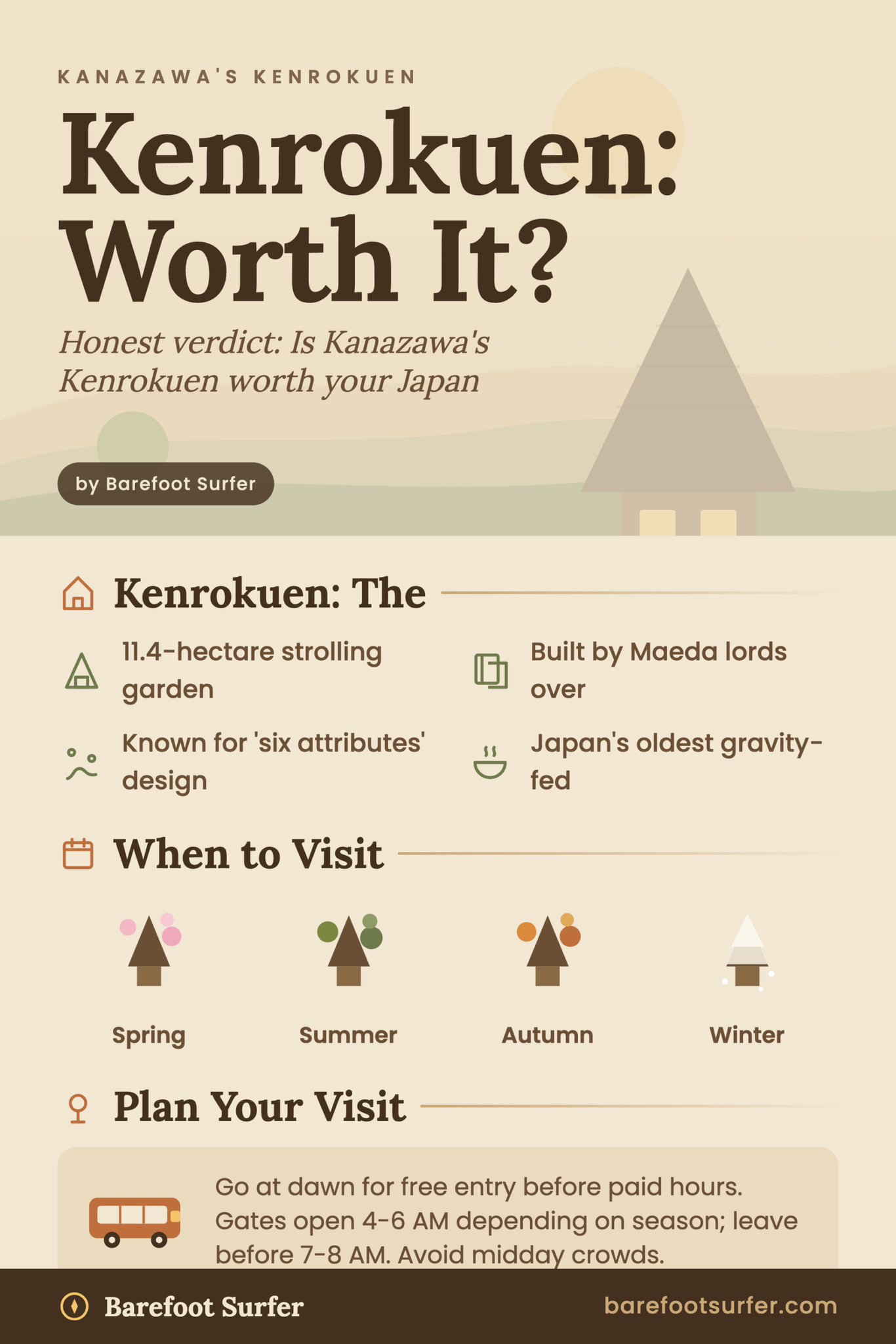
Kenrokuen is an 11.4-hectare strolling garden in the center of Kanazawa, built over close to two centuries by the Maeda lords who ran the wealthy Kaga domain. It was the outer garden of Kanazawa Castle until it opened to the public in 1874. Ponds, streams, a famous two-legged stone lantern, Japan’s oldest fountain running on nothing but gravity, teahouses, and pine trees held up in winter by cones of rope. That’s the literal description, and you can get that anywhere.
Here’s what living next door taught me that the brochures won’t. Kenrokuen is the single most touristed spot in Kanazawa. It is the one place in the city where you are guaranteed to be surrounded by tour groups and selfie sticks if you show up at the wrong hour. That is not a knock on the garden. It is a knock on the timing most visitors default to.
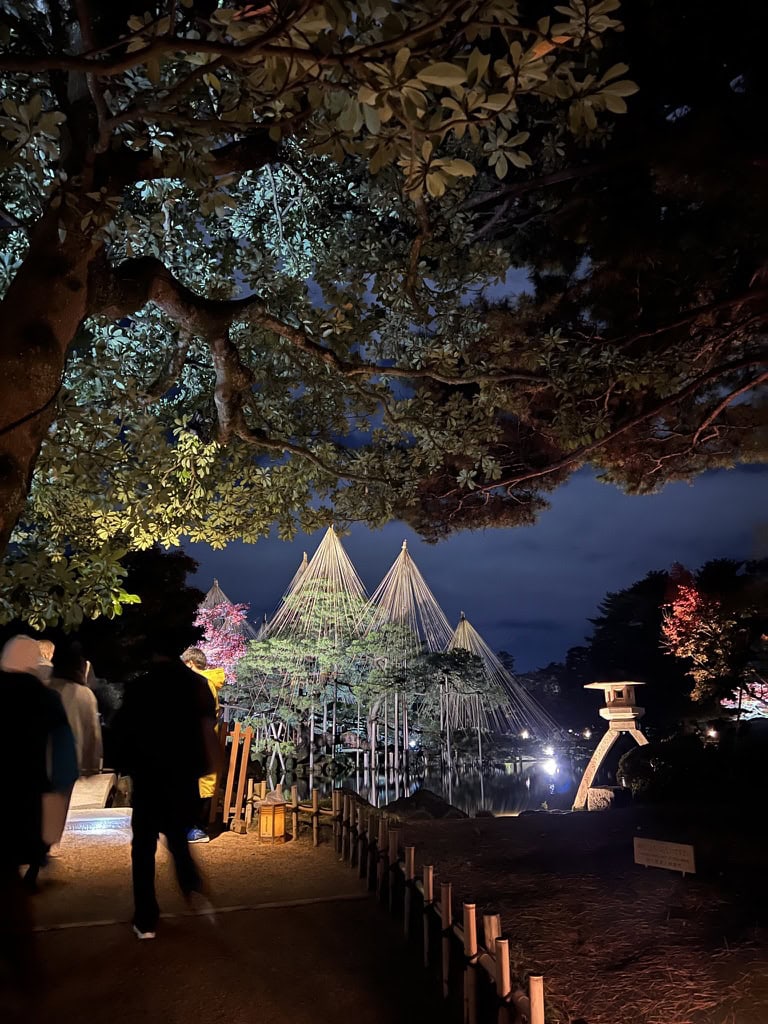
My first time was at night, in November, and it caught me off guard. It was actually my first visit to Kanazawa at all. We did a quick loop through the garden before heading over to see Kanazawa Castle lit up, and the yukitsuri were already up, those rope cones strung over the pines to brace them for snow that hadn’t fallen yet. A couple drinks in, walking through a dark, quiet garden with the lit trees held in rope and almost nobody around, I remember thinking, this is really nice. I want to come back here. Not mind-blowing. Just genuinely peaceful and a little beautiful, which at night with the crowds gone is exactly what this place does best.
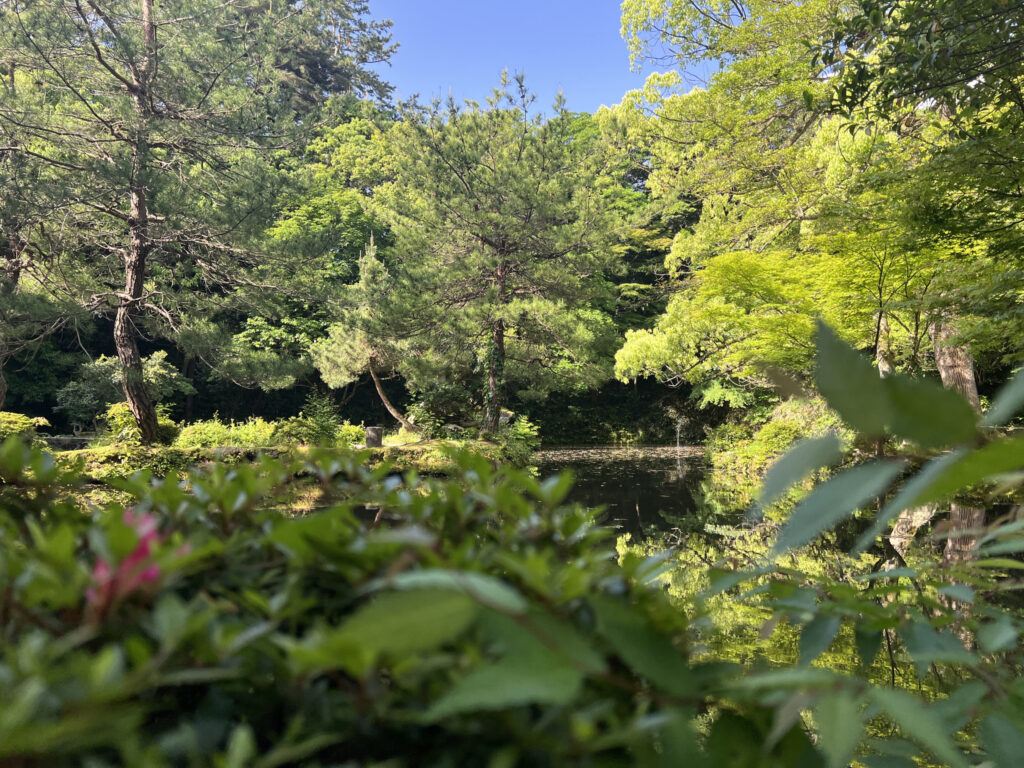
Then I came back in summer, in daylight, and got a completely different garden. More on that below, because it’s the whole reason timing is this article’s entire point.
The thing I want you holding onto: this garden rewards intention and punishes autopilot. Walk in informed and at the right time and it’s quietly stunning. Walk in like a tour bus and it’s a pretty park you queued for.
The “Six Attributes”: What Do They Actually Mean for a Visitor?
The name Kenrokuen means roughly “garden of the six attributes,” and every guide lists them like a shopping receipt: spaciousness, seclusion, artifice, antiquity, water features, and broad views. The name comes from an old Chinese landscape text that argued no single garden could ever hold all six at once, because they contradict each other. A garden that feels vast can’t also feel secluded. One that shows off human craft can’t also feel ancient and untouched. Kenrokuen’s whole claim to fame is that it pulls off all six anyway.
Here’s what that actually means as you walk, so you’re not just nodding at a plaque.
Spaciousness and seclusion are the contradiction you’ll feel first. The path opens onto the big Kasumigaike pond with a wide sweep of sky, then two minutes later folds you into a tight, mossy corner by a stream where you can’t see anyone. That deliberate switching between open and hidden is the design working on you.
Artifice and antiquity is the next pair. Everything here is built, the hills, the water flow, the placement of every rock, yet it’s old enough that it reads as natural. The fountain is a flex of engineering from the 1860s, gravity-fed with no pump. The “raised root” pine has roots that have crept above the soil over a century. Built, but earned its age.
Water features and broad views is the last pair, and it’s why you keep moving. Streams thread the whole garden, and the high ground gives you a long view out over the city and the hills beyond. You don’t stand in one spot at Kenrokuen. You walk a loop, and the six attributes reveal themselves in sequence. Knowing that before you go is the difference between “nice garden” and “oh, I see what they did here.”
Planning Your Kenrokuen Day: Avoiding the Typical Tourist Traps
This section is the whole game. Get the timing right and everything else falls into place.
When to Visit Kenrokuen (And When to Avoid It Completely)
The best time of year depends on what you want. Cherry blossoms peak in early April, fall foliage runs roughly mid-November into early December, and winter brings the yukitsuri, the rope cones strung over the pines to protect them from heavy Hokuriku snow, installed in late November and left up until around mid-March. Summer is green and quiet with iris blooms. There is no bad season. There are only bad times of day.
And this is the part I’ll plant my flag on. I caught the magic version of Kenrokuen by luck, at night with the ropes up. The version you can actually plan on, free and available year-round, is the early morning. The single best decision you can make at Kenrokuen is to go at dawn, during the free early-morning entry, before the paid hours even start. The garden opens its Mayumizaka and Katsurazaka gates for free before the ticket counters open, year-round. The window shifts with the season, as early as 4:00am in midsummer, around 5:00am most of the year, and 6:00am in deep winter, and you have to leave before paid hours begin (7:00am in the warm half of the year, 8:00am from mid-October through February).
Why this matters so much: the dawn garden is the photographed garden. Mirror-still pond, low gold light on the lantern, nobody in your frame, and the only sounds are water and birds. It is also completely free. The exact same garden, three hours later, is a paid, crowded, shoulder-to-shoulder shuffle. Same address. Different planet. If you do one thing with this article, set an alarm.
When to flat-out avoid it: weekends during cherry blossom peak. Entry is often made free during the bloom and the illumination, which sounds great until you realize “free” plus “peak sakura” plus “Saturday” equals a crowd so dense you can’t stop walking to look at anything. Go on a weekday, or go at dawn, or both.
Here’s my honest experience of the other end of it. I went back in summer, in the middle of the day, and it was a different place entirely. Big crowds of tour groups, hot, and the garden itself, stripped of the snow ropes and the night hush and any color in the leaves, was fine. I’ll be straight with you: it felt like walking into a nice park, just one without the playground and with the trees placed a little more thoughtfully. I took a friend visiting from the States through it in early May and got the same read. Pleasant, touristy, nothing that knocked me flat.
And I’ll tell you what I haven’t done, because the whole point of this site is that I don’t fake it. I’ve never seen Kenrokuen in deep winter. But I’d bet money it’s the best version of the place. The mountains around where I lived in Toyama are honestly underwhelming in summer, flat and green, and then winter and early spring hit, the tops go snow-capped, and suddenly you can’t stop looking at them. Same region, same logic. A summer-noon Kenrokuen is a nicer-than-average park. A winter Kenrokuen, snow sitting on those rope cones, is almost certainly the photo you fell in love with.
One honest current note: parts of Kenrokuen and the neighboring Kanazawa Castle Park took damage in the Noto Peninsula earthquake on New Year’s Day 2024, and some sections have been under repair since. I was an hour east in Toyama when that quake hit, holding a doorframe while the fridge emptied itself onto the floor, so I take it seriously. Check the official site for current closures before you build your morning around a specific spot.
How Long Does Kenrokuen Really Take? (And What Else to See Nearby)
A full, unhurried loop of Kenrokuen takes about 60 to 90 minutes. If you’re focused and just want the central pond, the famous Kotoji lantern, and the main landmarks, you can do a tight version in 30 to 45 minutes. Add another 20 to 30 if you stop for tea.
Here’s why the time matters for your day. Kenrokuen is not a half-day commitment, and you shouldn’t treat it like one. The smart play is to stack it with what’s right next door. The Katsurazaka gate spills you straight out onto a cherry-lined street with cafes and Kanazawa’s gold-leaf ice cream, and Kanazawa Castle Park is a two-minute walk across the road. The 21st Century Museum of Contemporary Art and the old Nagamachi samurai district are both close. A dawn loop of the garden, then the castle, then breakfast, then a samurai-district wander is a genuinely great morning that doesn’t blow a whole day on grass.
The Tea House Experience: Worth the Yen or a Skip?
There are working teahouses in the garden where you can sit overlooking the pond with a proper bowl of matcha and a wagashi sweet, generally open from around 9:00am to late afternoon. The fee is modest, a few hundred yen, and the appeal is obvious: a quiet, seated pause in the middle of the walk instead of just trooping past everything.
I’ll be honest with you: I skipped it. I’ve sat for tea in a lot of places around Japan, and the Kenrokuen teahouses never gave me that “I have to do this” pull. So here’s my real read. If you’ve never done a proper matcha-and-wagashi sit-down and you want one in a pretty setting, the few hundred yen is fine and the pond view is genuinely nice. But if you’ve done tea elsewhere, or you’d rather have the real thing in one of Kanazawa’s old teahouse districts, this is a clean skip. It’s a pleasant add-on, not a reason to come.
Getting to Kenrokuen: Easy or a Hassle?
Easy. Genuinely easy, which is rare enough in Japan that it’s worth saying plainly.
From Kanazawa Station’s east exit (the one under the big wooden Tsuzumi-mon gate, signposted as the Kenrokuen exit), you have several bus options that all drop you a short walk from the gates. The tourist-friendly Kanazawa Loop Bus runs a flat ¥220 per ride for adults and circles all the main sights. JR buses on the same run cost about ¥210 and are free if you’re carrying a Japan Rail Pass. Either way the ride is roughly 15 to 20 minutes, and you get off at the Kenrokuen-shita / Kanazawa Castle stop, then walk a few minutes uphill to the gate. If you’re going to bounce between several sights in one day, a Loop Bus one-day pass (around ¥600) pays for itself after three or four rides.
A taxi from the station is about 10 minutes and ¥1,200 to ¥1,500, which is honestly worth it if it’s raining (Kanazawa gets sudden coastal showers) or you’re a group splitting the fare. And if you’re staying central, the whole castle-garden-samurai core sits inside a roughly two-kilometer radius, so you can walk a lot of it.
The Final Verdict: Is Kenrokuen Worth a Day on Your Japan Trip?
No. Not a whole day. But it is absolutely worth a morning, and here’s the honest split.
Kenrokuen is worth it if you catch it transformed and uncrowded: at dawn during the free entry, at night during a seasonal light-up, in winter with snow on the ropes, or at least on a weekday outside peak sakura. Stack it with the castle and the samurai district so it’s a great half-day rather than a whole one. Done that way, it’s beautiful, historic, often free, and quiet, and it earns its reputation completely.
Kenrokuen is a skip if the only window you have is a weekend midday at peak season, you’re short on days, and you’re chasing something that feels singular and yours rather than the photo everyone brings home. At that hour, in that crowd, it’s a pretty park you queued for, and your irreplaceable day deserves better.
The deciding factor isn’t the garden. It’s your alarm clock and your calendar. Set them right and it’s a yes.
If Not Kenrokuen, Then What? (Kanazawa Alternatives for Your “Special” Day)
If Kenrokuen doesn’t fit, or you want the day to feel like yours, Kanazawa and the wider Hokuriku region have you covered, and most of it is far less photographed to death.
In the city itself, the Nagamachi samurai district and the Higashi Chaya old geisha quarter are, in my opinion, the more rewarding wander precisely because they’re quieter than the Kyoto and Takayama versions everyone funnels into. You get the old streets and the earthen walls without the bus-tour density.
And if you’re genuinely willing to venture further into rural Hokuriku, that’s where the trip stops looking like everyone else’s. The mountains, the seafood at its actual source, the small towns where you’ll be the only foreigner all day. That’s the version of this region I’d chase if I were you, and it’s the whole reason I stayed three years.
Ready to make Kanazawa happen? The honest move is to lock your base now while you can still cancel free, then build the morning around it. Don’t let the good dates slip away while you’re still auditing tabs at 11pm. Find your stay in Kanazawa on Booking.com and you’ve turned “we’ll think about it later” into a decision.
For more Trips around Kanazawa and Hokuriku Region of Japan
- Planning Your Perfect Kanazawa Itinerary, maps to your outline’s first placeholder
- Kanazawa: The Complete Travel Guide From a Local
- Toyama vs Kanazawa, used in the “venture further / something that’s yours” alternatives section
- Takayama Full Guide, regional alternative
Outline placeholders with NO real article yet (left unfilled, not invented):
- “Exploring Ishikawa Prefecture: Beyond the Golden City”, no matching URL in site index. Closest live option is the Toyama Prefecture Guide if you want to repurpose; otherwise leave as [INTERNAL LINK PLACEHOLDER].
- “Hokuriku Region Travel Guide: My Honest Take”, no Hokuriku-region guide live yet. Leave as [INTERNAL LINK PLACEHOLDER] until published.