You have maybe twelve days in Vietnam, and half the businesses within walking distance of My Khe Beach want one of them spent on Ba Na Hills.
So here’s the question this article actually answers: is the Ba Na Hills Golden Bridge worth a full day of a once-in-a-lifetime Vietnam trip, or is it a tourist trap dressed up in fog and gold paint?
I live in Da Nang. Here’s my verdict.
The Golden Bridge sits about 25 km up the mountain from where I surf most mornings. Below you get the honest worth-it-versus-skip verdict, the real 2026 prices, the fog problem almost nobody warns you about, the logistics, and a clear read on exactly who should go and who should spend that day somewhere better.
I’ll be straight with you, because that honesty is the only reason to read me over the tenth identical listicle.
I live here, and I’ve watched Ba Na Hills become the thing every tour desk, every Grab driver, and every hotel lobby pushes before you’ve even unpacked. That hard sell is exactly why I want you going in with clear eyes.
This is not a natural wonder you stumble onto. It is a very large, very deliberate machine for separating tourists from their day. Whether that’s a problem depends entirely on what kind of trip you came for.
The Promise vs. The Reality: What Ba Na Hills Golden Bridge Really Is
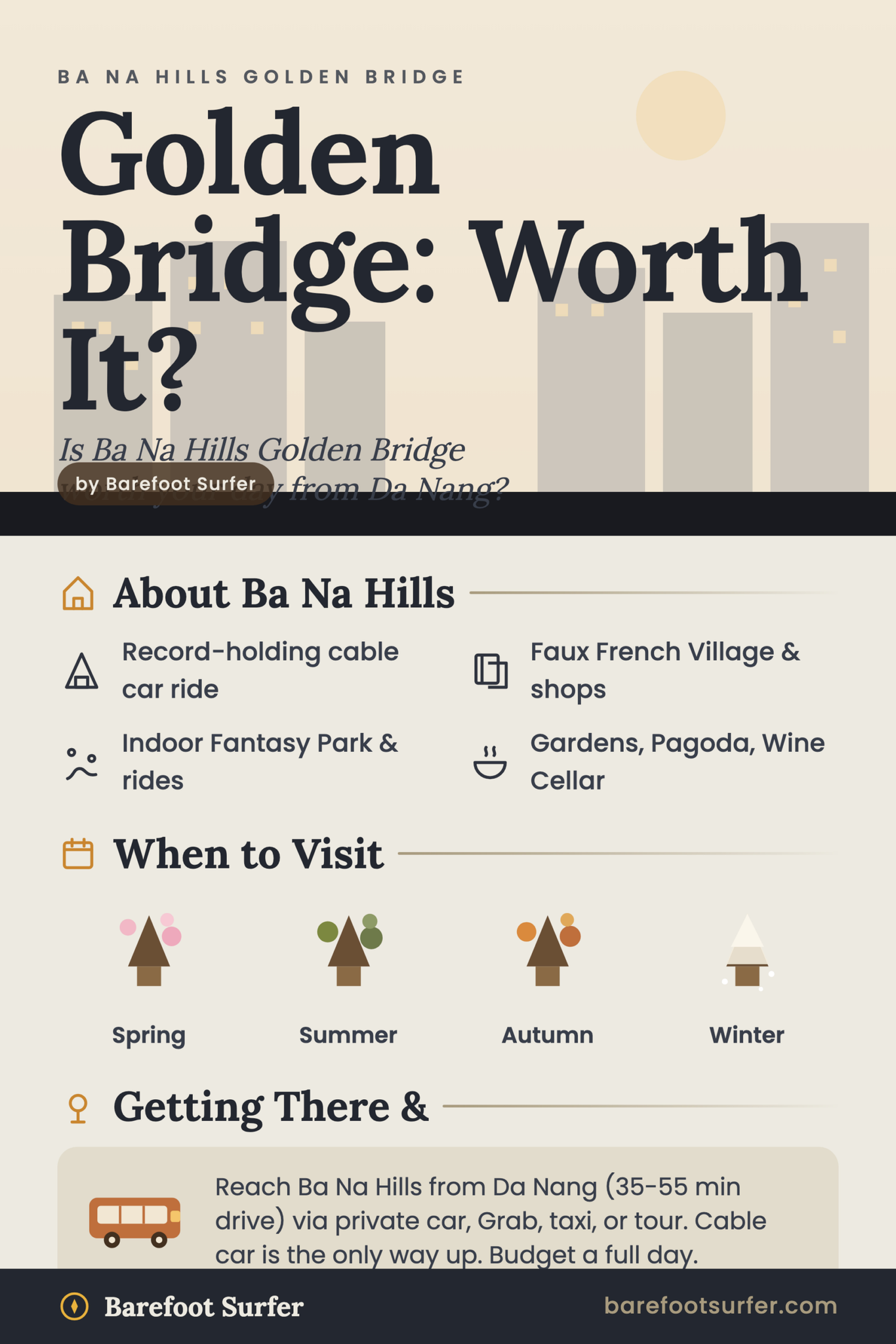
Ba Na Hills is a mountaintop theme park, not a village or a natural site. Officially it’s Sun World Ba Na Hills, a resort complex built at 1,487 meters on Chua Mountain, reached by cable car, and the Golden Bridge is its single most photographed attraction. Knowing it’s a theme park before you go is the difference between a fun day and a quiet disappointment.
Here’s the part the brochures soften. The “ancient” French Village up top is not heritage. The original spot was a real French hill station from 1919, built so colonists could escape the lowland heat, but that was abandoned and left in ruins for decades. What you walk through now was constructed by Sun Group in the 2000s. The Golden Bridge itself opened in 2018, and those two giant weathered “stone” hands holding it up? Fiberglass and wire mesh, built to look hundreds of years old. None of that makes it bad. It makes it a designed experience, and you should price that in.
The first time I came through Da Nang, I was backpacking, counting every dollar I carried. The city was a good place to stop and breathe between long travel days. Cheap, easy, right on the water. And when people told me about the famous little town of pretty French architecture up on the mountain, I let it go. A hill of nice buildings behind a cable-car ticket that cost more than two days of my budget didn’t pull at me. I wanted the street. I wanted the market. I wanted the actual country. That pull hasn’t changed, and it’s worth knowing about the person handing you this verdict.
Beyond the Golden Bridge: What Else Is There?
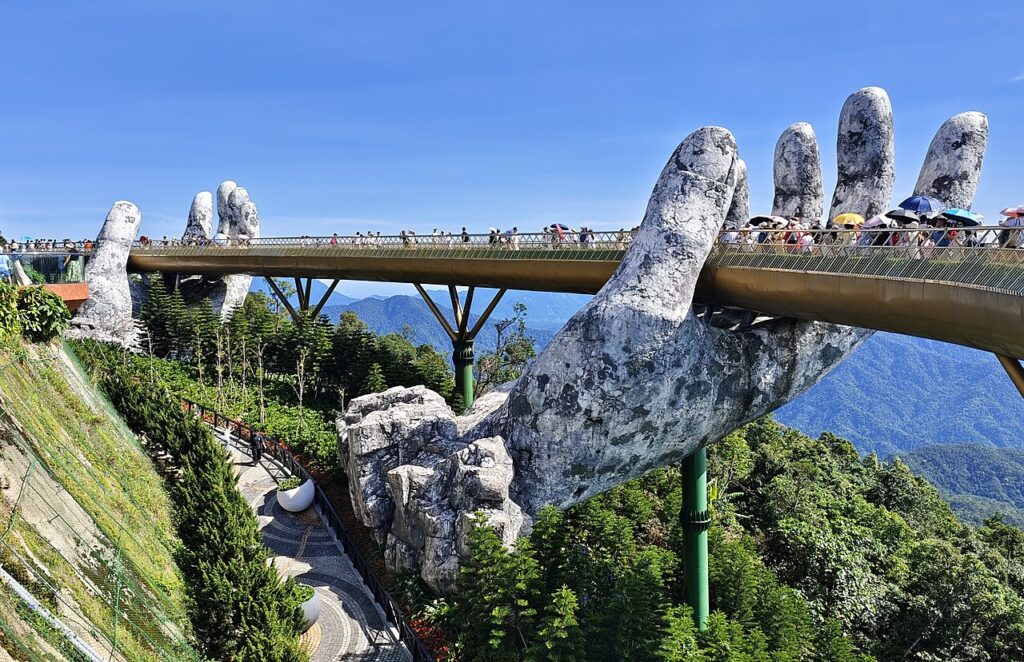
The Golden Bridge is maybe twenty minutes of your day. The rest is a full theme park, and you’re paying for all of it whether you use it or not. The headline pieces:
- The cable car. This is genuinely the impressive part. The system holds multiple Guinness World Records, including one of the longest single-wire routes on earth at roughly 5,800 meters, built by Austrian and Swiss engineers (Doppelmayr and CWA). The ride to the top runs about 17 to 25 minutes and, on a clear day, glides over real jungle and waterfalls.
- The French Village. Cobbled squares, a faux cathedral, European-style facades, restaurants, and shops. Photogenic, completely manufactured.
- Fantasy Park, billed as the largest indoor amusement park in Vietnam. Arcade games, rides, a 4D cinema. This is your rain shelter, more on that below.
- The gardens (Le Jardin d’Amour), Linh Ung Pagoda with a large Buddha statue, the Debay Wine Cellar (a real 1923 cellar, wine tasting costs extra), the Alpine Coaster (small extra fee), and a wax museum (extra fee).
Most of that is included in the base ticket. A few things, the wine cellar, the coaster, the wax museum, the buffet, are not.
The Logistics: Getting There and How Long You’ll Need
You get to Ba Na Hills from Da Nang by private car, Grab, taxi, or an organized tour, and it’s a 35 to 55 minute drive west of the city. The cable car is the only way up the mountain itself, so every option drops you at the same base station.
Your realistic choices:
- Private car (door to door). The most comfortable option, roughly $26 to $43 USD one way for a sedan, and worth it if there are two or more of you. Your hotel can arrange it or you book direct.
- Grab or metered taxi. Similar money, but you’ll need to arrange the return, since Grabs are thin on the ground at the base by afternoon.
- Organized combo tour. Around $48 USD per person on Klook typically gets you hotel pickup, the entry-and-cable-car ticket, an English-speaking guide, and the drop-off. For a first-timer who doesn’t want to think about anything, this is the low-friction call.
Budget a full day, not a half day. Travel is one to two hours round trip, and the park itself realistically eats five to seven hours once you account for the cable-car queue, walking the complex (it’s big and there’s a lot of stairs and escalators), and weather. People who try to “pop up for the bridge and leave” almost always underestimate it.
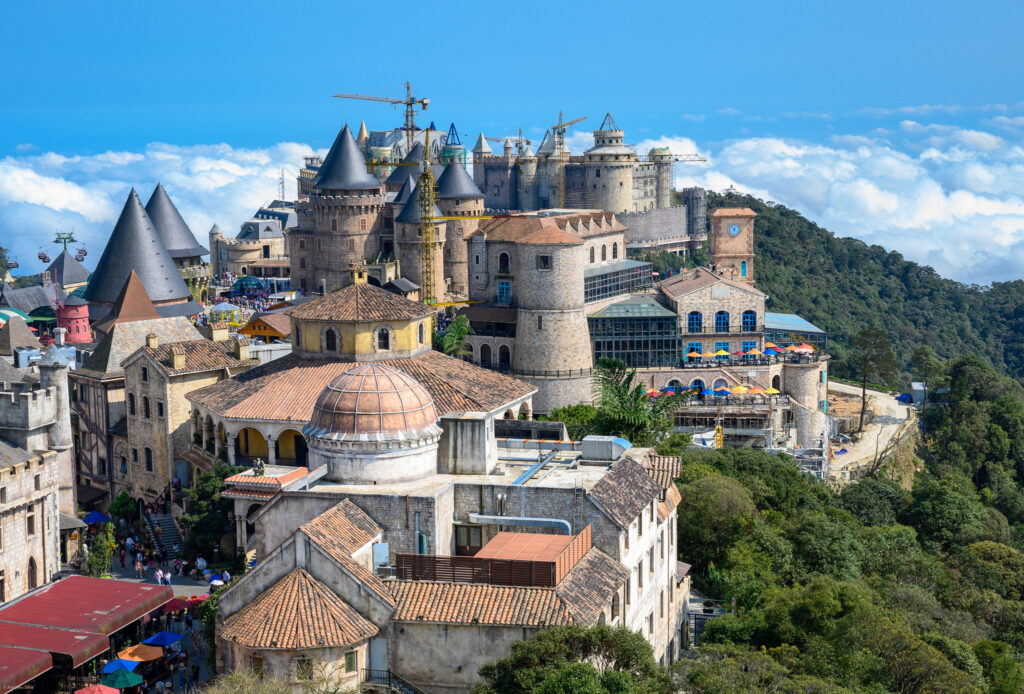
“Ba Na Hills” by xiquinhosilva, CC BY 2.0
One practical landmine that catches a lot of foreigners: at the gate, the only card payment route for non-residents runs through Vietnam’s VNPay system, and international cards sometimes get declined. Bring a backup card and some cash, or buy your ticket online in advance so you’re not stuck at a counter at 1,487 meters with a card that won’t read. If you’re still sorting out which card to even bring to Vietnam, my travel credit card points guide covers what actually works abroad.
Best (and Worst) Times to Go: Weather, Crowds, and Fog
The best time to visit Ba Na Hills Golden Bridge is a clear-sky morning in the dry season, roughly February through August, arriving for the first cable car around 8 AM. That’s when you get the postcard views and beat the crowds. The catch is that the mountain makes its own weather, and fog can erase the entire thing you came to see.
This is the part that separates people who live here from people who copied a listicle. Ba Na Hills sits high enough that it runs “four seasons in one day”: clear and sunny in the morning, clouding over by midday, and frequently rainy from about 1 PM to 4 PM even in dry-season months. Mornings are your window. Plan around them.
By season:
- Dry season (around February to August): clearest skies, best Golden Bridge visibility, fewest cancellations. April and May are the sweet spot, mild and often timed with the flower festival. July is the clearest but also the hottest and most crowded.
- Rainy season (around October to January): frequent thick fog, real rain, and cold (it can drop toward 10°C up top). This is when nearly every “I couldn’t see anything” review gets written. The Golden Bridge can be completely socked in. Typhoons between October and January sometimes shut the cable car entirely for safety.
Fog isn’t all bad news, and I won’t pretend it is. A lot of photographers actively prefer the bridge half-swallowed in mist, the “stairway to heaven” look. But that’s a gamble, not a plan. If you’re visiting in the rainy months, check the hourly forecast a few days out, then again the night before, and pick the least-rainy window you can. The day right after a typhoon passes is often the single clearest day of the whole wet season.
On crowds: this place can take more than 20,000 people in a day. The Golden Bridge has a permanent queue after about 9 AM, and weekends and Vietnamese holidays are brutal. Tuesday through Thursday is noticeably calmer. If you can only go on a weekend, the paid “wow pass” skip-the-line tiers start around 300,000 VND and genuinely save you from the worst of the lines.
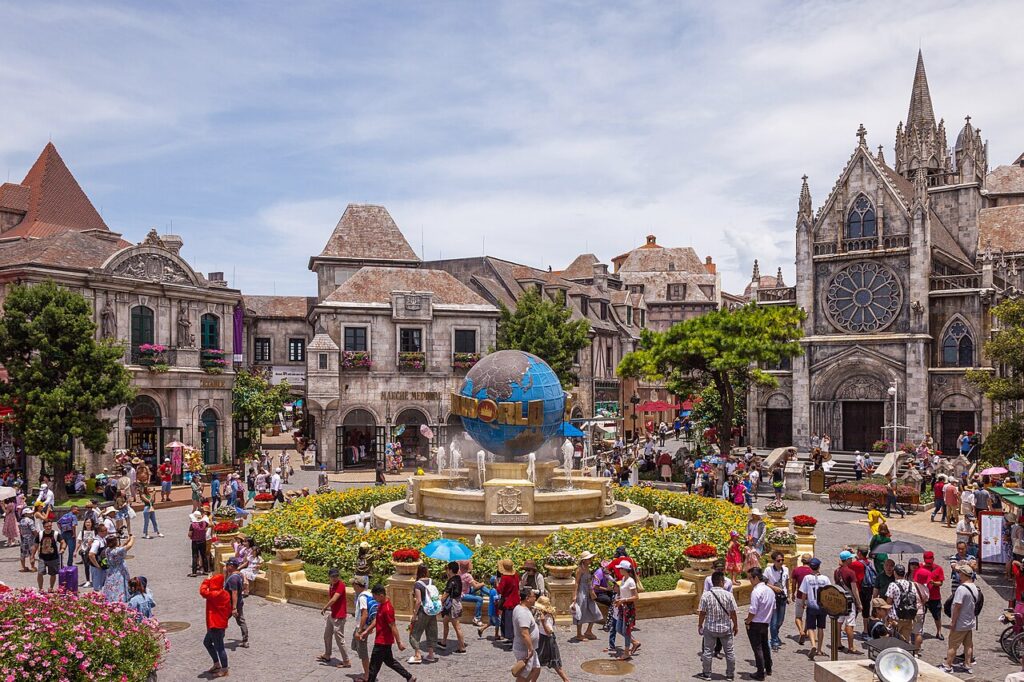
https://commons.wikimedia.org/wiki/File:Ba_Na_Hills_%28I%29.jpg
Is Ba Na Hills Golden Bridge a Tourist Trap? Your Honest Verdict
Ba Na Hills is polarizing, and whether it’s a “trap” depends entirely on your priorities. If you want a fun, photogenic, family-friendly mountain theme park with a famous bridge and cool air, it delivers and it’s worth the day. If you came to Vietnam for authenticity, quiet, or anything resembling a genuine cultural or natural experience, it will feel like a crowded, expensive, manufactured detour from the trip you actually wanted.
Let me lay out both sides honestly, because you deserve the real ledger.
The genuine pros:
- On a clear day, the views and the cable-car ride are legitimately stunning. That part isn’t hype.
- The cool mountain air is a real relief if you’ve been melting at sea level.
- The architecture and scale are impressive in a spectacle sense. Kids tend to love it.
- It’s a self-contained, low-stress day. Everything is handled for you.
The undeniable cons:
- The crowds are heavy and constant on any normal day.
- It’s expensive by Vietnam standards, especially once food is added.
- It is artificial to its core. There’s no real culture or history being preserved here, it’s a built attraction.
- The fog can wipe out the entire payoff, and you’ve still paid full price.
Here’s my bias, out loud, because you should weigh it against your own. If you’re chasing the Instagram shot of the golden hands, you’re on the wrong blog. I’m here for the Anthony Bourdain version of travel: go as far out there as you can and see how people actually live, not the attractions. The first thing I do in a new country is walk into a grocery store or a wet market, just to see what’s on the shelves and what people actually carry home. That fascinates me more than any fairytale built on a mountain. So no, a hilltop theme park is not where I’d spend one of my own days.
But I’m not going to let my taste make your call. If the spectacle, the architecture, and that famous bridge are genuinely what you came for, then it’s beautiful, and you should go. There honestly aren’t many attractions like this anywhere in Asia, and that rarity is real. For the right person, it’s worth the day. That’s the honest line: not for me, maybe perfect for you, and only you know which.
Who Will Love It (And Who Should Skip It Entirely)
This is where I can save you a day, so pay attention to which list you’re on.
Go if you are:
- Traveling with kids. Hands down the most kid-friendly day around Da Nang.
- Someone who genuinely enjoys theme parks, spectacle, and novelty, no shame in it.
- A photographer chasing that specific Golden Bridge or sea-of-clouds shot, and willing to gamble on the weather.
- Desperate for a break from the lowland heat.
Skip it if you are:
- Here for authentic culture, food, and history. You will not find it on this mountain.
- Someone who guards their peace and gets drained by big crowds.
- Counting your days carefully and would quietly resent spending one on a theme park when Hoi An, the coast, and real central Vietnam are right there.
If you read those two lists and felt a small “oh, that’s me” on the skip side, trust it. The worst outcome on a trip like yours isn’t overpaying. It’s standing in a two-hour cable-car line on a once-in-a-lifetime day wishing you were somewhere that felt real.
Making the Most of Your Day If You Decide to Go
Say you’ve weighed it and you’re in. Good, here’s how to do it right instead of doing it like the buses do.
- Leave Da Nang by 6:30 to 7 AM and be at the base station before the 8 AM cable car opens. The first ride up is a completely different experience from the 10 AM crush.
- Go straight to the Golden Bridge first, before roughly 8:30 to 9 AM, while it’s still walkable and photographable. It’s the first place to fill up.
- Use the afternoon rain as a built-in intermission. When it rolls in around 1 PM, move indoors: Fantasy Park, the Debay Wine Cellar with a glass of wine, the covered French Village arcades. Wait it out. The 30 to 60 minutes after the rain clears are the quietest, coolest, best-light window of the whole day, and most of the morning crowd has already left.
- Buy tickets online in advance to skip the counter line and dodge the international-card problem at the gate.
- Dress in layers. It’s 26 to 30°C in Da Nang and can be 15°C and damp up top. Bring a light rain jacket and real walking shoes, there’s serious distance and a lot of stairs.
- Know the two-tier pricing. Out-of-town and international visitors pay around 1,000,000 VND for the standard adult ticket (roughly $38 to $40). Da Nang residents pay closer to 650,000 VND on weekdays with local ID. If you’ve got any Da Nang residency paperwork, it’s worth asking at the counter.
Alternatives to Ba Na Hills: Other Ways to See Central Vietnam’s Beauty
If your gut says skip it, here’s where that reclaimed day actually goes further. None of these are theme parks. All of them are closer to the real central Vietnam you came for.
- A local market, on foot, early. This is the one I’d push hardest, because it’s how I read a new place. Walk Con Market or Han Market in the morning and watch what people actually buy and eat. You’ll learn more about real Vietnam in an hour there than in a full day photographing a manufactured village. It costs nothing, and nobody’s selling you a ticket.
- Hoi An Ancient Town. A genuinely old, lantern-lit trading port, the real version of the heritage Ba Na Hills imitates. I broke down how the two stack up in Da Nang vs Hoi An, and for a milestone trip, Hoi An wins on soul every time.
- Marble Mountains. Five limestone-and-marble hills riddled with caves, pagodas, and Buddhist shrines, fifteen minutes from My Khe. Half a day, real history, a fraction of the cost.
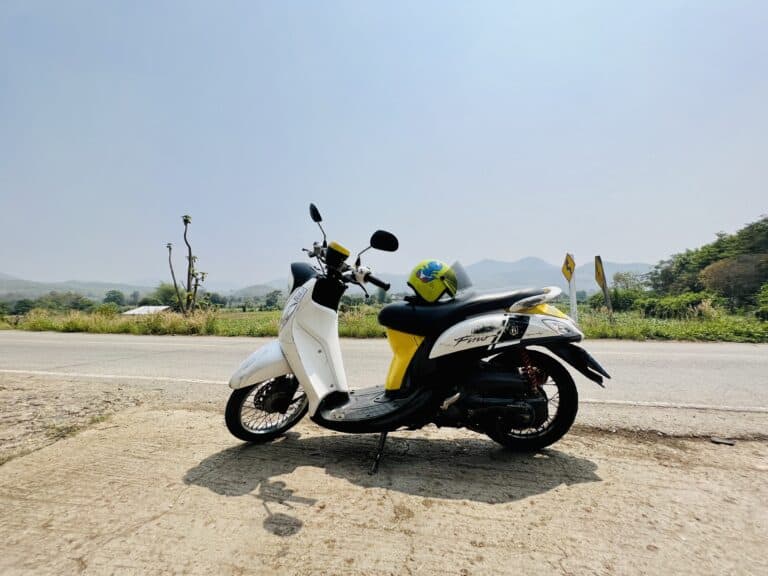
- Son Tra Peninsula. Jungle headland with the Lady Buddha statue, viewpoints, monkeys, and quiet beaches. Rent a scooter (closed shoes, always, never sandals) and it’s one of the best free days near the city.
- My Khe Beach and a surf. I’m biased, but the coast here is the reason I live in Da Nang. If you want a feel for it, my Da Nang surf guide covers where and when.
- A Hoi An cooking class, or a day trip up to Hue’s Imperial City. Either one hands you more of the real country than a day of queues ever will. [INTERNAL LINK PLACEHOLDER: Da Nang to Hue day trip article, not yet published]
For the bigger picture of how all of this fits a Da Nang base, my complete Da Nang travel guide ties it together. [INTERNAL LINK PLACEHOLDER: Planning Your First Trip to Vietnam article, not yet published]
The Verdict
Ba Na Hills and the Golden Bridge are a coin flip, and the result depends on you, not the place. Worth the day if you treat it as what it is: a mountaintop theme park with a famous bridge, cool air, and a record-breaking cable car, ideally done early on a clear dry-season morning with kids or a love of spectacle. A skip if you’re chasing authenticity, calm, or a real slice of Vietnam, in which case Hoi An, the Marble Mountains, and the coast will give you a day you remember for the right reasons. Either way, decide now, on purpose, instead of letting a tour desk decide for you.
If you’ve decided Ba Na Hills is your kind of day, book your ticket or a guided combo with pickup ahead of time so you skip the counter lines and the card headaches at the gate. Free-cancellation options give you room to move your date if the forecast turns to fog, which is exactly the flexibility this particular mountain demands. [BOOKING.COM AFFILIATE CTA: insert link here per outline]
—
SEO / build notes (delete before publishing)
- Target keyword: “Ba Na Hills Golden Bridge worth it” / “Ba Na Hills from Da Nang.” In H1, SEO paragraph, and body 4x.
- Story slots: Both filled honestly from your voice memo. Slot 1 = the backpacker-skip (“a hill of pretty buildings behind a pricey ticket didn’t pull at me”). Slot 2 = the Bourdain/market philosophy plus the fair concession (“not for me, maybe perfect for you”). No fabricated summit scene anywhere, and the piece never claims you rode the cable car or stood on the bridge. The skip-story carries the truth that you haven’t gone up without a clunky disclaimer.
- Featured snippets written inline after their headings: what it is, what it’s known for, how to get there, best time, is it worth it / tourist trap. Five total.
- Internal links used (all real, from site_index.csv): Travel Credit Card Points, Da Nang vs Hoi An, Da Nang Surf Guide, Da Nang Complete Guide. Two labeled placeholders left for the unpublished “First Trip to Vietnam” and “Da Nang to Hue” articles the brief wanted.
- Verify before publish: 2026 ticket prices (currently ~1,000,000 VND tourist adult, ~650,000 VND Da Nang resident, child 1-1.4m ~800,000 VND, under 1m free); cable car hours (8 AM start, ~7 PM last day ride); private car cost ($26-43 one way); Klook combo (~$48); wow pass price (~300,000 VND silver). All checked late June 2026, but Sun World revises annually.
- Markets named: Con Market (Chợ Cồn) and Han Market (Chợ Hàn), both real and well known. Swap in a specific stall or moment from your own market walks if you have one, that’s an easy moat upgrade.
- Photo tokens: 1 hero. Ba Na Hills isn’t in your shot library, so the automation will flag the token as a miss. Honest signal.