You have one day to give one of these two towns, and picking the wrong one is the kind of quiet regret that follows you home.
If you are deciding between Kanazawa and Takayama for your Japan trip, this is the honest verdict from someone who lived a 40-minute train ride from both for three years. I will tell you what each city actually feels like, which attractions are worth your time and which are just a photo op, how to get to each one now that the trains have changed, and which one I would send you to if you only get to pick one.
The Kanazawa or Takayama Question: Why It’s Not Obvious
Here is why this choice is genuinely hard, and why the ranking articles that shove both cities into a table of bullet points are lying to you by omission.
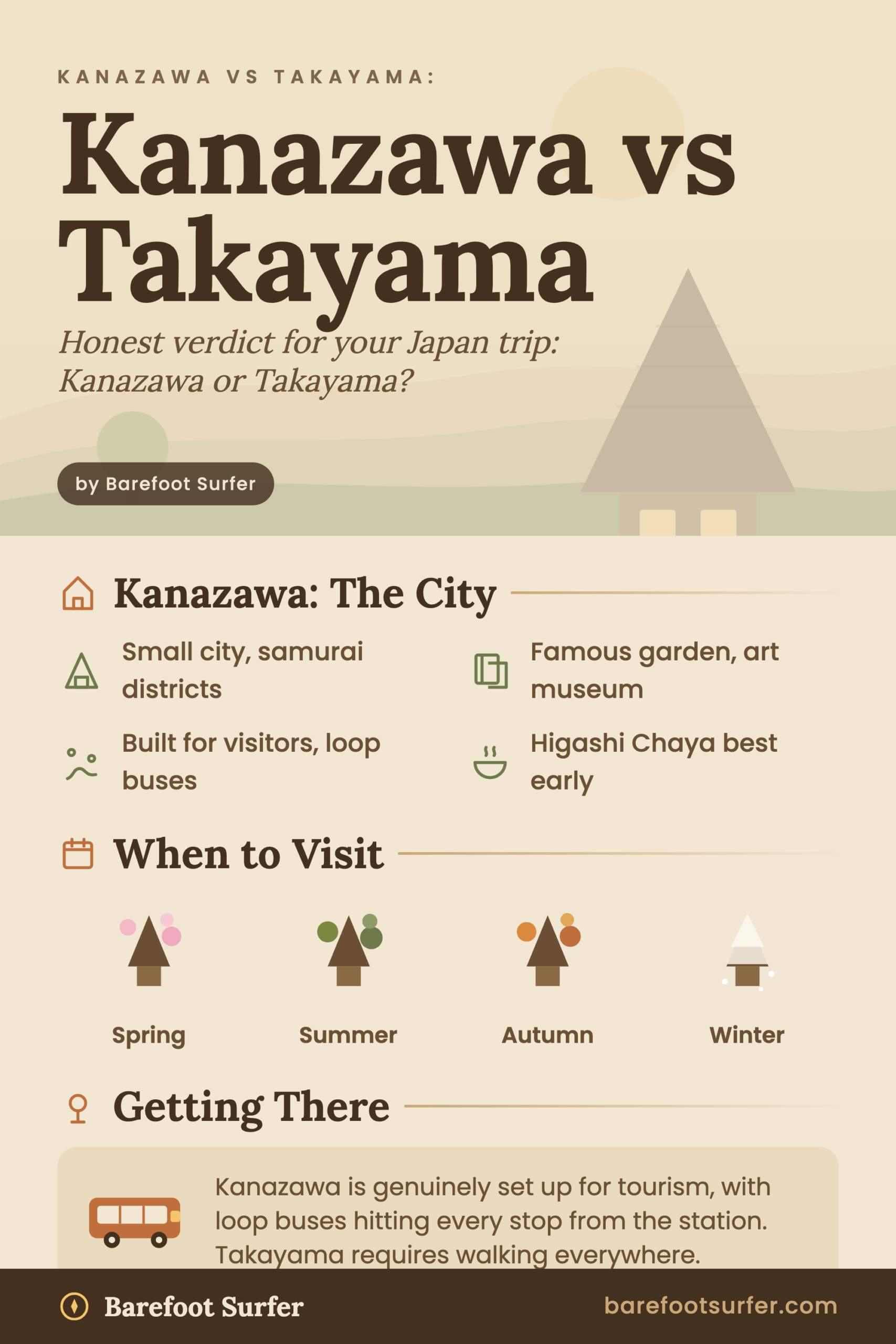
Kanazawa and Takayama get lumped together because they are both “the cultural one,” the stop you add when you want more than Tokyo, Kyoto, and Osaka. But they are not two versions of the same thing. One is a proper small city with samurai districts, a garden that ranks among the most famous in the country, and a contemporary art museum that people fly in for. The other is a preserved mountain town where the real magic happens in a two-hour window most day-trippers sleep through. Choosing between them is not about which is “better.” It is about which one matches the day you are picturing in your head.
The reason this matters so much: you are not going to redo this trip. So let’s make the call properly.
Kanazawa: What It Actually Feels Like to Be There
I did not see Kanazawa on my first trip to Japan. I went about a month after I moved to Toyama, when a friend invited me over for the castle illumination at night, and we took the train across. Here is the thing about Toyama Station: even at rush hour it is calm, quiet by the standards of anywhere that is not the actual countryside. We stepped off at Kanazawa and it was a different register entirely. Same simple kind of station layout, not a maze of exits, but the moment you walk out through the concourse it opens up taller and grander, and there are just more people moving. Then you clear the front of the station and there is the big wooden drum gate standing over the plaza, and I stopped and thought, okay, this is an actual city out here in the countryside. Let’s do this.
The other thing that hits you fast is that Kanazawa is built to catch a visitor. It runs loop buses that hit every tourist stop for a couple hundred yen a ride, so you hop on, pay, and it carries you from Kenrokuen to the museum to the tea house districts without a second thought. That sounds minor until you compare it. Takayama makes you walk everywhere. Even Toyama, which I know cold, has no attraction bus, just local lines and the tram to get you home. Kanazawa is the one out here that is genuinely set up for tourism, and you feel that the minute you arrive.
Which is also why it rewards time-of-day more than it rewards a checklist. The Higashi Chaya geisha district at 8am, before the tour groups, is a wooden-street quiet that most day-trippers never see. The same street at noon is a slow shuffle of selfie sticks. Go early. This is the single most useful thing I can tell you about the city.
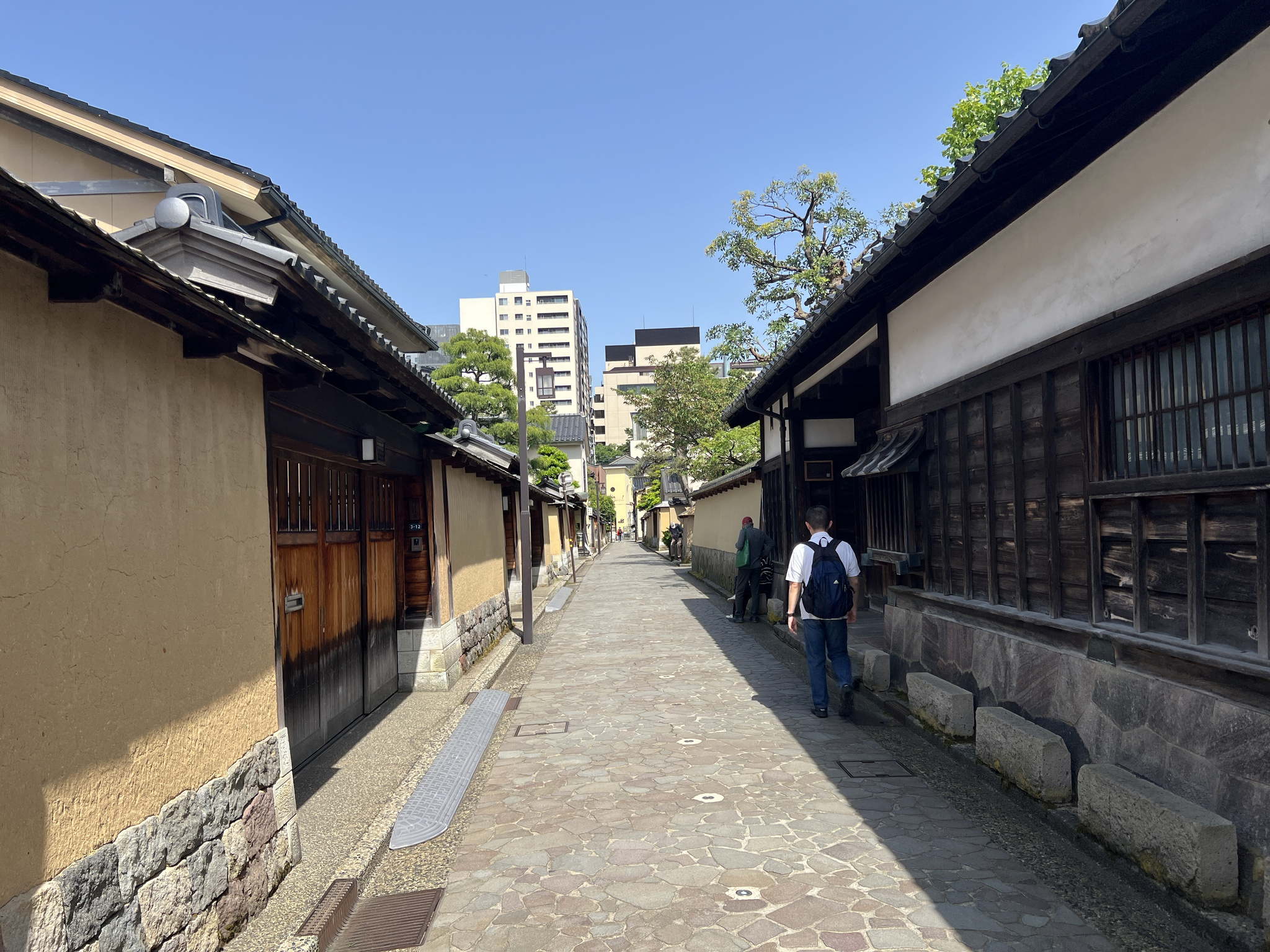
For the full breakdown of neighborhoods and where to base yourself, I wrote a complete local’s guide to Kanazawa that goes deeper than I can here.
Kanazawa’s Top Attractions: Worth Your Time or Just a Photo Op?
Here is my worth-it or skip verdict on the big four, from someone who took visiting friends around these more times than I can count.
Kenrokuen Garden. Worth it, and go first thing. It genuinely earns its reputation, and it is one of the rare famous sights that is better than the hype rather than worse. Entry is around ¥320 for adults. Get there at opening, because by mid-morning the main viewpoints are three people deep. In winter the pines wear their yukitsuri rope supports, and that is the version worth planning around.
21st Century Museum of Contemporary Art. Worth it, and it is the thing your friends won’t have. This is Claire’s “special and hers” card. It is a circular, glass-walled museum with Leandro Erlich’s famous swimming pool installation, and it is genuinely good, not obligatory-art-museum good. Book the paid exhibition zone ahead in busy seasons.
Omicho Market. Worth it, with a warning. Great for a fresh seafood lunch, kaisendon piled with local catch. Just know it is a working market that now gets serious tourist traffic, so prices at the sit-down counters are not local prices anymore. Go for the experience and the food, not for a bargain.
Higashi Chaya District. Worth it only if you go early. Covered above. Beautiful at 8am, a crush by lunch.
The one I will add that the brochures undersell: Myoryuji, the so-called Ninja Temple. Full of hidden staircases and trapdoors, and it is genuinely clever. But you must reserve by phone in advance, tours are in Japanese with an English leaflet, and you cannot just walk up. That single logistics detail is where most travelers get turned away at the door.
Eating and Drinking in Kanazawa: Beyond the Sushi Hype
Yes, the sushi is excellent, Kanazawa sits on the Sea of Japan and the fish is the real reason to eat here. But do not stop at the obvious. The local specialty worth chasing is jibuni, a duck-and-wheat-gluten stew thickened into something between a soup and a gravy, the kind of humble regional dish that never makes a listicle because it does not photograph well. Order it in a quiet spot near Nagamachi rather than a station-front tourist restaurant. This region also does gold-leaf everything, including gold-leaf soft-serve ice cream, which is a pure gimmick and, honestly, kind of fun to do once and never again.
Takayama: What It Actually Feels Like to Be There
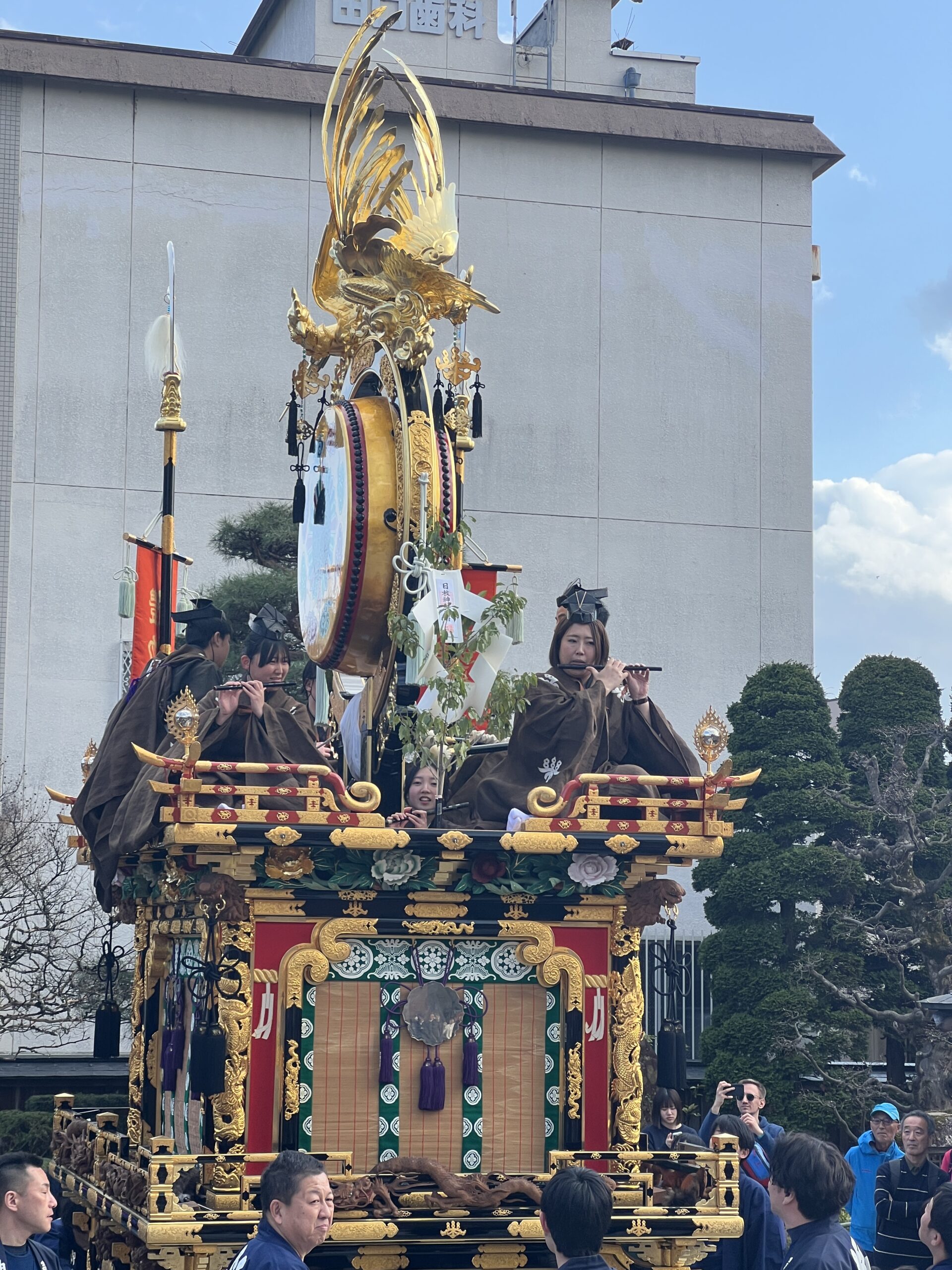
Takayama is smaller than Kanazawa, a Hida mountain town of dark wooden merchant houses, sake breweries with cedar balls hanging out front, and a river running through the middle. Its whole character lives in the morning, and I want to be honest with you about what that actually means, because a lot of writeups oversell it.
Almost every time I went to Takayama I was on the first train in, home around sunset, sometimes later. And here is the truth: even on the first train, you are not arriving to an empty town. Takayama is not a secret. It is well known enough that it shows up in every serious Japan guidebook, so the moment you step out you are not in a Japanese-only town the way you would be in Toyama. There are foreign travelers everywhere, all day. What the early train buys you is not solitude. It buys you the town before it gets crazy, which is a real and worthwhile difference, because by late morning Sanmachi Suji, the main old street, is a genuine crush of tour groups and narrow lanes.
So the move is to use the early hours with intent. Hit the morning market first, get any souvenirs sorted and off your plate while the stalls are fresh. Then, once the cafes and shops really open a bit later, sit down for a proper breakfast if you are a hungry sort. And then you walk straight into the attractions with the whole day ahead of you and the worst of the crowds still behind you. That rhythm, market, breakfast, sights, is how you get the good version of Takayama instead of the 11am-bus-crowd version.
If Takayama is looking like your pick, my full Takayama guide covers the timing and the day-trip pairings in detail.
Takayama’s Top Attractions: Worth Your Time or Just a Photo Op?
The morning markets. Worth it, and they are the reason to be here early. Two of them, one by the Miyagawa river and one outside Takayama Jinya, both open around 7am and winding down by noon (they start at 8am December through March). Go for the atmosphere and the pickles and the old vendors, not to buy much. This is the real Takayama, and it closes before most tourists are even out.
Takayama Jinya. Worth it if you like history. A preserved Edo-era government house, the only one of its kind left. Entry is ¥500 for adults, free for under-18s. Calm, well-preserved, and rarely crowded. A solid 45 minutes.
Hida Folk Village (Hida no Sato). Worth it, and underrated. An open-air museum of relocated thatched-roof gassho farmhouses. Entry is ¥700 for adults. It is a 30-minute walk or a 10-minute Sarubobo bus from the station, and it gives you the Shirakawa-go style architecture without the Shirakawa-go crowds. If you are not adding Shirakawa-go to your route, this is your substitute, and it is a good one.
Sanmachi Suji old town itself. Worth it at the right hour, a photo op at the wrong one. See above. Timing is everything.
Eating and Drinking in Takayama: It’s Not Just Hida Beef
Hida beef is the headline, and it deserves to be, a skewer of it grilled at a street stall is one of the great cheap luxuries in Japan. But eat around it too. Takayama is sake country, with several centuries-old breweries you can taste at right in the old town, look for the cedar ball, the sugidama, hanging over the door, which traditionally signals fresh sake. And try mitarashi dango, the soy-glazed rice dumplings grilled over coals, savory here rather than sweet like the Kyoto version. It is a small thing, but it is the taste I associate with a cold Takayama morning.
Side by Side: Key Differences for Your Specific Japan Trip
Stripping it down to what actually changes your decision:
Overall feel. Kanazawa is a refined small city you explore. Takayama is a preserved mountain village you absorb. Kanazawa gives you range across a full day. Takayama gives you a mood in a shorter window.
Cultural depth. Kanazawa wins on breadth: garden, samurai district, geisha quarter, castle, contemporary art, all in one walkable city. Takayama wins on concentration: one perfectly preserved streetscape and a living folk tradition.
Food. Close, but different. Kanazawa is seafood and refinement. Takayama is mountain food, beef, sake, and grilled snacks.
Pace. Kanazawa fills a day comfortably and can hold two. Takayama’s core is a half-day done right, stretched to a full day with the Folk Village or a Shirakawa-go pairing.
The crowd problem. Both have one. In Kanazawa it is concentrated at Kenrokuen and Higashi Chaya and beatable by going early. In Takayama it swamps the single main street midday and is beatable the same way. Early riser or not is genuinely a factor here.
Getting There and Around: What to Expect for Transport
This is where I can save you from an out-of-date article, because the trains in this region changed recently and a lot of guides still have the old information.
Getting to Kanazawa. From Tokyo, the Hokuriku Shinkansen runs straight there. The fastest Kagayaki service does it in about 2 hours 25 minutes for roughly ¥15,000 to ¥16,000 one way. Easy, frequent, comfortable. Here is the part that trips people up: if you are coming from Kyoto or Osaka, the old direct Thunderbird limited express to Kanazawa no longer exists. Since March 2024 the Thunderbird terminates at Tsuruga, where you transfer up to the Hokuriku Shinkansen to finish the trip to Kanazawa. It is a clean, well-signed transfer, allow 10 to 15 minutes, but if you booked your day around an article promising a one-seat ride from Kyoto, you will be confused at Tsuruga. Now you won’t be.
Getting to Takayama. The classic route is the Limited Express Hida from Nagoya, about 2 hours 25 minutes and around ¥5,510 one way. The trains are the newer HC85 hybrids now (the old “Wide View” name is gone), and the ride up the Hida river gorge is genuinely beautiful, sit on the correct side and it is half the reason to go. From Tokyo it is a transfer at Nagoya, roughly 4.5 hours total.
Doing both. They are close, but there is no direct train. You route through Toyama (Shinkansen to Toyama, then the Hida down to Takayama, a little over 2 hours), or you take the direct Hokutetsu/Nohi highway bus between Kanazawa and Takayama, which for most people is the simplest option. The bus is reserved-seat only, so book ahead, especially in autumn and around festivals. One more current note: the Takayama-to-Toyama rail stretch was suspended for months and only reopened at the end of May 2026, so double-check it is running when you travel.
One thing to watch for, from riding these regional lines constantly for three years. At a lot of Japanese stations, big and small, a train will pull up to the platform you are standing on, going the direction you want, and it is still not your train. You sometimes have to walk way down to the far end, which is technically a different platform on the same line, and the two trains can come within five minutes of each other. If you hop on the wrong one without knowing, everything feels fine, you are moving in the right direction, until twenty or thirty minutes in the line forks into a Y and you realize you are on the wrong branch. It throws first-timers off completely. Once you know it exists, you just check the platform marker and the car destination and it stops being a problem.
The reassuring flip side: the actual JR trains here are almost supernaturally punctual. Even a local train in the middle of nowhere that only runs once every two hours will be there to the exact minute. It is the buses and the local trams that drift late, because they are stuck in traffic or waiting on a single-track section, not the trains. So plan tight connections around the trains with confidence, and leave yourself a cushion when a leg depends on a bus.
For the wider train-planning picture, I’ll link my Japan rail guide here once it’s live: [INTERNAL LINK PLACEHOLDER: Japanese Train Travel Guide]. If you are still setting up how you’ll pay for all of this without eating foreign transaction fees, my travel credit card points guide is the boring-but-important read.
Quick answers to what you’re probably Googling
Which is easier to get to, Kanazawa or Takayama? Kanazawa is easier from Tokyo, a direct 2.5-hour Hokuriku Shinkansen with no transfers. Takayama takes a transfer at Nagoya and about 4.5 hours from Tokyo. From Nagoya, though, Takayama is the simpler one at roughly 2.5 hours direct.
Is Takayama too touristy? The main old-town street gets genuinely crowded from late morning to mid-afternoon, especially on weekends and during festivals. Early morning and evening it empties out and feels like the real mountain town again. It is not too touristy if you time it. It absolutely is if you don’t.
The William Verdict: Kanazawa or Takayama for Your Trip?
No fence-sitting, here is the call.
If you only get one day, go to Kanazawa. For the traveler taking a first, careful, once-in-a-lifetime trip who wants something that feels real and not like everyone else’s photo carousel, Kanazawa gives you more of it in a single day: a top-tier garden, a genuine samurai quarter, a geisha district, and a contemporary art museum your friends back home almost certainly have not been to. It is the more complete day, it is the easier arrival, and it holds a second day well if you have one. That is the “special and hers” trip with the least logistical risk.
Pick Takayama instead only if you are already routing through the Japanese Alps or Shirakawa-go, and what you are actually chasing is the quiet, the wood smoke, and a 7am morning market in the mountains. In that specific case Takayama is the more atmospheric, more singular experience, and it slots into that route naturally. Do it right, which means sleep there and be on Sanmachi before the buses arrive, or don’t bother with more than a half-day.
For most people reading this, deciding between the two for a broad first Japan trip: Kanazawa is the one, and add Takayama only if the days and the route genuinely allow it. That is the honest answer.
Is Kanazawa or Takayama better for a first-time Japan trip? For a first trip with limited days, Kanazawa is usually the stronger single choice: it offers more variety, richer cultural depth, and the easiest access from Tokyo. Takayama wins if you specifically want a quiet, preserved mountain-town experience and are already traveling through the Alps region.
If this sounds like your kind of Japan, you can find places to stay in either city on Booking.com below. I’ve pulled together the ones that actually feel like the place you came for, a machiya townhouse in Kanazawa, a wooden inn near Takayama’s old town, rather than another beige business hotel by the station. Free cancellation on most of them means you can lock in the good ones now while they’re available and change your mind later if your route shifts. No pressure, just don’t leave the nice ryokan to chance in autumn.
[INTERNAL LINK PLACEHOLDER: My Favorite Places to Stay in Kanazawa / My Favorite Places to Stay in Takayama]
What to Consider Next for Your Japan Itinerary
Once you’ve made the call, the next question is how the city plugs into the rest of your trip. If Kanazawa won, it pairs naturally with the wider Hokuriku region and works as a base, and my Kanazawa itinerary maps out how to spend one or two days without wasting a step. If you landed on Takayama, build in the early morning and consider the Shirakawa-go or Hida Folk Village add-on so the day has a second act.
Either way, you are no longer choosing blind. You know what each place feels like, what to skip, when to show up, and how to get there on trains that actually exist in 2026. That was the whole job. Go book the one that matches the day you keep picturing, and give it your full attention when you get there. You’ve got this.
—
How many days do you need in Kanazawa or Takayama? Kanazawa comfortably fills 1.5 to 2 full days for its main sights. Takayama’s old town is a strong half-day done early; stretch it to a full day or two by adding the Hida Folk Village or a Shirakawa-go day trip. Neither needs more than two days on a standard itinerary.
What is the main difference between Kanazawa and Takayama? Kanazawa is a larger, refined city rich in Edo-period culture: gardens, samurai and geisha districts, a castle, and a modern art museum. Takayama is a smaller, preserved mountain town of Edo-era wooden streetscapes, morning markets, traditional crafts, and Hida beef. City range versus mountain-town concentration.