The word “ninja” in the name is doing a lot of work, and not all of it is honest.
If you’re weighing whether Kanazawa’s Ninja Temple (Myōryū-ji) earns a slot in a trip where every half-day counts, this is the straight version. I lived in Toyama for three years, about forty minutes up the line from Kanazawa, and I spent most of it in Japanese. That’s the lens here. I’ll tell you exactly what this place is, how the booking actually works, what the tour involves, and the one question that decides whether you should go or skip it. No hype. Just the call.
What Is Kanazawa’s “Ninja Temple,” Really?
Here’s the snippet answer first, because it matters: Myōryū-ji is a real working Nichiren Buddhist temple built in 1643, not a ninja training ground. No ninjas ever lived or trained here. The nickname comes entirely from the building’s hidden defensive architecture, which is genuinely clever, and the real story behind it is more impressive than the marketing.
Let me explain why, because this is the part most guides skip.
The True Story of Myōryū-ji’s Design
The Maeda clan ran the Kaga Domain out of Kanazawa, and they were the richest family in Japan that wasn’t the Tokugawa Shogunate. Roughly one million koku of rice income. When you’re that rich and you’re not the people in charge, the people in charge watch you very closely. The Shogunate banned outside lords from building fortifications, and banned buildings over three stories, specifically so clans like the Maeda couldn’t prepare for a fight.
So the Maeda cheated, quietly. They relocated a belt of temples to the south of the castle (the Teramachi district you’ll walk through to get here) and another belt to the north, forming a defensive line disguised as places of worship. Myōryū-ji was the key outpost in that line. From the street it looks like a modest two-story temple. Inside, it’s actually four floors stacked into seven levels, with 23 rooms, 29 staircases, and a lookout tower over the Kaga plain. All of it built to look like nothing from the outside.
That’s the thing to hold onto. This isn’t a ninja gimmick. It’s a 380-year-old workaround engineered by people who weren’t allowed to defend themselves and did it anyway, in plain sight, under the nose of a government that would have punished them for it. That’s a better story than ninjas, and it’s true.
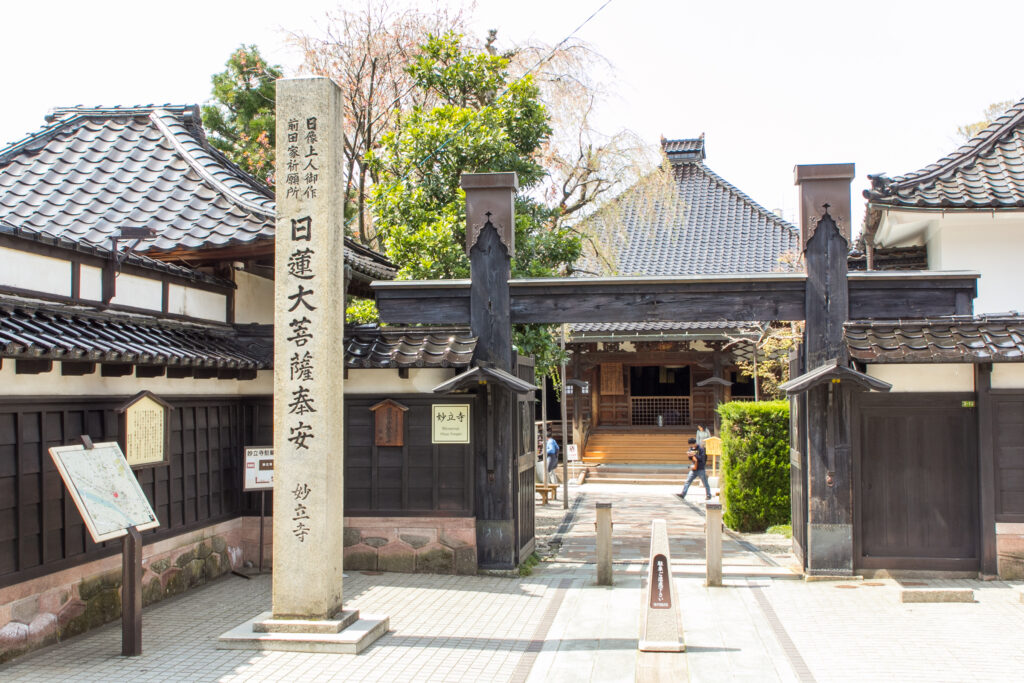
What You’re Actually Seeing Inside
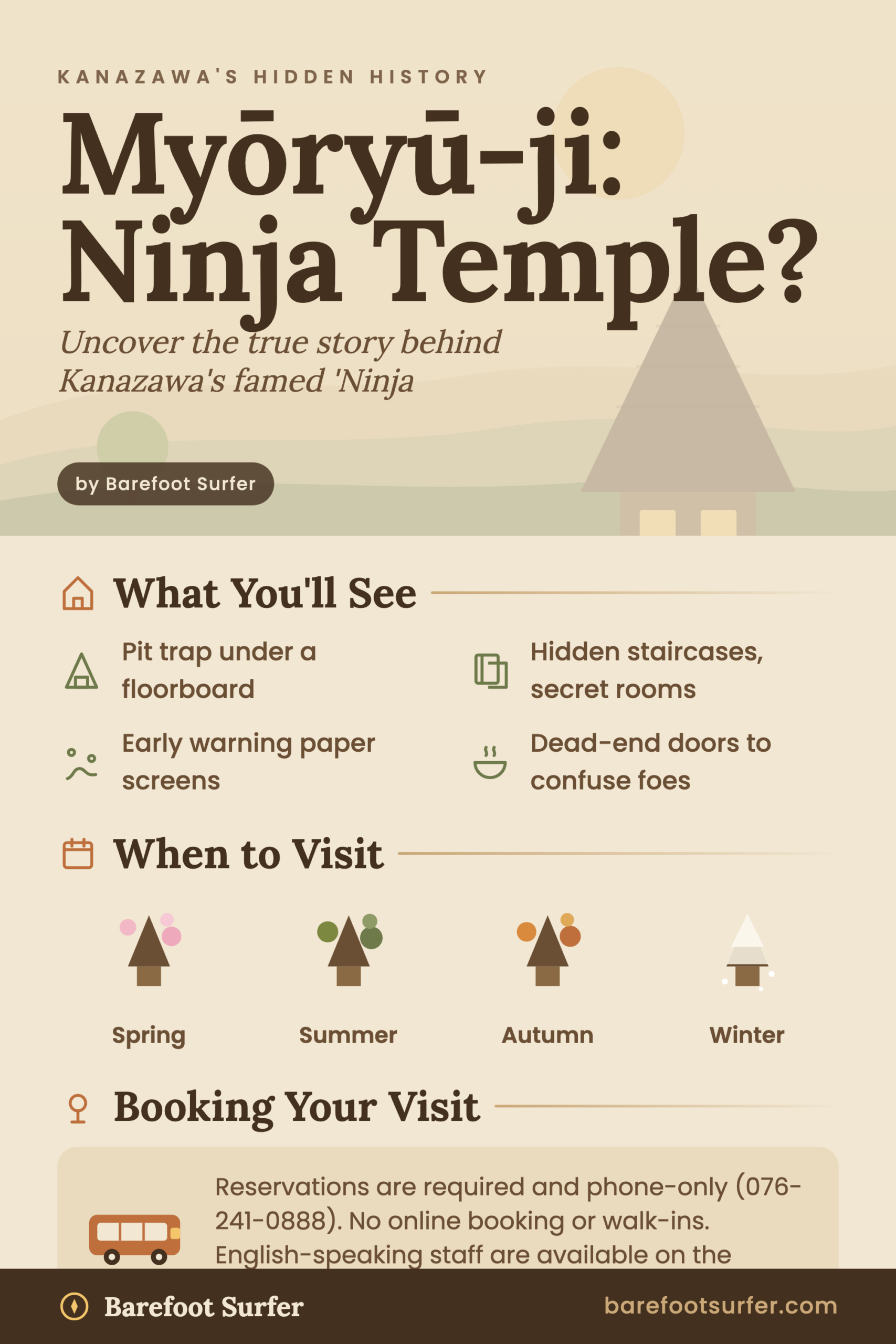
The tour walks you through the tricks one by one. A pit trap hidden under a floorboard. A staircase concealed beneath the floor that only appears when the boards are lifted. A paper-screen door rigged so the shadow and footsteps of anyone approaching show through before they reach it, an early warning system. Dead-end doors meant to confuse an intruder. A well in the kitchen rumored to run all the way to Kanazawa Castle. And a small inner room with a door that locks from the outside, the place a cornered lord could end things on his own terms rather than be captured.
It’s compact. The whole thing runs about 40 minutes, and you move at the guide’s pace in a single group. No photography is allowed inside. That bothers some people. I’d argue it’s the right call, and it makes you actually look instead of shooting through your phone.
Booking Myōryū-ji: What You Must Know Before You Go
This is where people waste the day, not at the temple itself. The booking trips up more first-time visitors than anything inside the building, so read this part twice.
Snippet answer: You must reserve Myōryū-ji in advance by phone. There is no online booking, no walk-in tickets, and tours run on a timed schedule. That’s the real friction. Not the language. The phone.
Getting Your Reservation: It’s Not Walk-In Friendly
Here are the facts that actually matter, current as of 2026:
- Reservations are required and phone-only. The number is 076-241-0888, and the reservation line is open 8:30 to 17:00.
- There is no online reservation system. Anyone selling you a “ticket” online is selling a packaged tour wrapped around the temple, not skip-the-line entry. The temple itself only takes phone bookings.
- You can book in English. This is the part competitors get wrong. Myōryū-ji keeps English-speaking staff on the reservation phone. You do not need Japanese to book this. You need to be willing to make a phone call.
- Have your details ready when you call: your name, nationality, number of people, the ages of any kids, and how you’re getting there. They ask all of it.
- Tours run 9:00 to 16:00. On weekdays they’re roughly hourly. On weekends and holidays they run every 30 minutes. Winter uses the weekday (hourly) schedule, so slots are tighter in the cold months.
- Same-day booking sometimes works if there’s space, but on a tight itinerary, don’t gamble. Call a few days ahead.
- If you’re late, it’s treated as a cancellation. Build in buffer. The Teramachi buses are not always punctual.
There is nothing exotic about a Japanese phone reservation once you’ve made a few. When I lived in Toyama, booking anything, a restaurant, a haircut, a delivery, meant picking up the phone and doing it in Japanese, so here’s the part that actually matters: the language is not the wall on this one. Myōryū-ji keeps English-speaking staff on the line. The wall is that it’s phone-only and timed, and the people who assume they can stroll up and buy a ticket at the door are the ones who lose the slot and the half-day. If making the call yourself feels like too much, ask your hotel or ryokan front desk to book it for you. That is a completely normal thing to ask in Japan, and they will do it.
The Guided Tour: Language Barriers and Expectations
Snippet answer: The tour is conducted entirely in Japanese. Foreign visitors are given an English guide booklet to follow along, and live interpretation is not permitted inside. So you’ll hear the guide speak Japanese while you read the matching section in your booklet as the group moves room to room.
That format is standard across a lot of Hokuriku’s smaller historic sites, and it works better than it sounds on paper. The guide talks, you read the matching page, and the building carries the rest. You’re looking at trapdoors and hidden staircases, not sitting through an abstract lecture, so the visual does the heavy lifting and the booklet keeps you oriented. What you lose without the language is the texture: the guide’s asides, the small jokes, the timing of a point landing. If that texture is the thing you care about, that’s the honest case for booking a packaged tour with an English-speaking guide who briefs you on the history before you go in, because the temple’s own tour stays Japanese either way.
So, Is Myōryū-ji Worth Your Precious Day in Kanazawa?
Short version: yes, if you came for the real history and the cleverness of the place, and you’re willing to make one phone call. Skip it if you’re picturing a ninja attraction with costumes and throwing stars. That place exists in Kanazawa too, separately, and it is not this.
Here’s how to know which one you are.
Who Should Definitely Go
Go if you’re the kind of traveler who gets a little lit up by how a thing was built and why. If “they disguised a fort as a temple to outsmart the Shogunate” made you lean in, you’ll love the 40 minutes. History people, architecture people, anyone who wants a Kanazawa memory that isn’t the same garden photo everyone brings home. It costs ¥1,200 for adults and ¥800 for schoolchildren, cash only, which is nothing for what it is. This is a small, dense, genuinely unusual thing to have seen, and almost no one back home will have done it.
Who Should Consider Skipping It
Skip it if you’re expecting ninjas. There are none, and if that’s the fantasy you’re carrying, the real building will feel like a letdown through no fault of its own. Skip it if a timed phone reservation and a Japanese-language tour sound like more stress than a vacation should carry, that’s a completely valid call, and pretending otherwise would be lying to you. Preschool-age children aren’t allowed inside at all for safety reasons, so families with little kids should plan around that, not against it.
What to Do Instead (If You Skip Myōryū-ji)
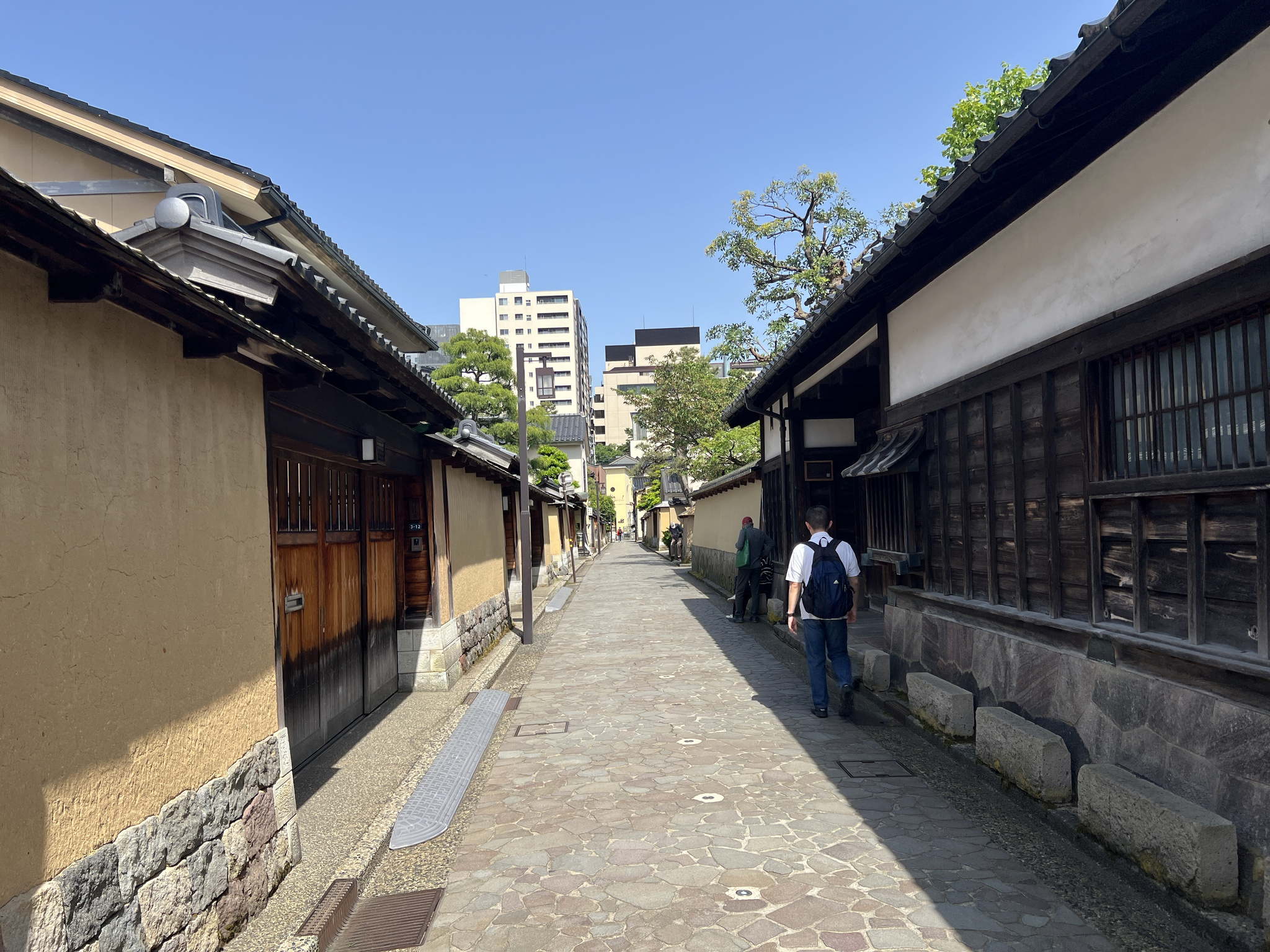
Good news: the temple sits in one of the better corners of Kanazawa for wandering anyway. Myōryū-ji is in the Teramachi temple district, and right around it is the Nishi Chaya District, a small former geisha quarter that gets a fraction of the crowds of the famous Higashi Chaya across town. Walk the temple lanes. They’re quiet, real, and free.
From there it’s a short hop to the Nagamachi Samurai District, the old earthen-walled merchant and samurai streets, which I’ll defend hard precisely because they stay calm in a way Kyoto’s equivalents stopped being years ago. If you want the headline sights, Kenrokuen Garden is the one everyone names, and the move there is to go right at opening (it’s free at dawn before the official hours), not midday when the tour buses land.
One honest aside on food, since people come to Kanazawa for the seafood: it’s good, but it is not the revelation the city’s reputation promises, and I’ll get into why I’d actually rank the catch up the coast in Toyama over Kanazawa’s if you want the unfiltered version.
Before you lock in your Kanazawa base, here’s the practical bit: stay somewhere central enough to reach both Teramachi and the castle without burning time on buses. Free-cancellation rooms mean you can hold a good spot now and adjust as your plan firms up, no pressure, just don’t leave it until the good central places are gone.
Check central Kanazawa stays on Booking.com (free cancellation) →
Beyond Myōryū-ji: Pairing It With Other Kanazawa Highlights
Myōryū-ji is a 40-minute thing, so the smart play is to build a half-day around it rather than treating it as a standalone trip across the city. Reserve a late-morning slot, then spend the rest of the time in its own neighborhood: the Teramachi temple walk, Nishi Chaya, and Nagamachi all sit on the southwest side, so you’re not crisscrossing town. Save Kenrokuen, the castle, and the Higashi Chaya district for a separate block on the other side of the river.
If you want the whole flow mapped out, I’ve laid out how I’d actually structure a day in Kanazawa and the full local guide to the city with the timing and transport details worked out. For getting around Hokuriku in the first place, [INTERNAL LINK PLACEHOLDER — JR Pass / Hokuriku transport guide], and for the garden specifically, [INTERNAL LINK PLACEHOLDER — Kenrokuen guide].
Reserve the temple. Walk the quiet lanes around it. Skip the ninja fantasy and take the real story instead, the one about a family who built a fortress and called it a prayer hall. That’s the version worth your day.