The wrong bag doesn’t ruin your trip on day one. It ruins it slowly, one sore shoulder and one fumbled train connection at a time, until you’re standing on a platform in Kanazawa wondering why you’re already exhausted at 10am.
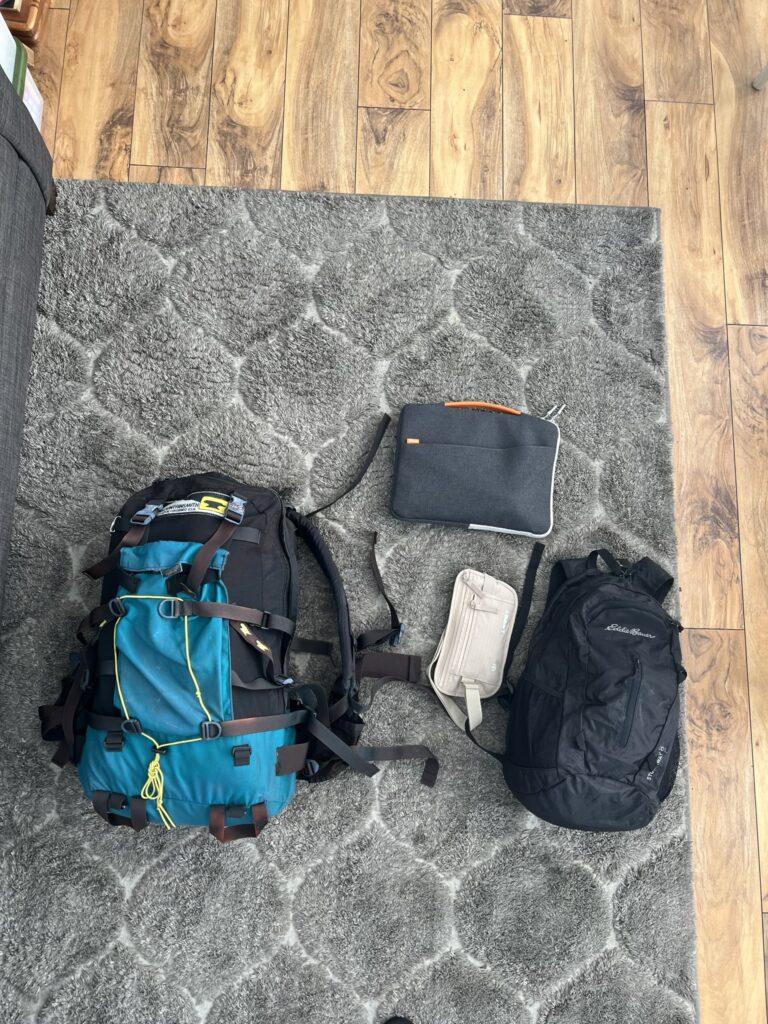
Three years ago, I carried one bag for eight months. Europe, Southeast Asia, Taiwan, then Japan, where I ended up living for almost three years. It was a 45-liter, carry-on-sized rock climbing pack my dad had owned for thirty years, a basic hip belt and nothing else, none of the modern support. I packed it to about 12kg and never once checked it. That bag taught me what matters in a travel backpack the slow way, by not having most of it. This is the honest verdict on what to carry for an independent trip through Japan or Southeast Asia: what genuinely matters, what’s marketing noise, and the one call that saves you days. Not a hiking pack. Not a suitcase. The right travel backpack.
Backpack or Suitcase for Your Japan/Southeast Asia Trip? Let’s Be Honest
If you’re picturing yourself gliding through Japan with a sleek wheeled suitcase, I need to gently stop you.
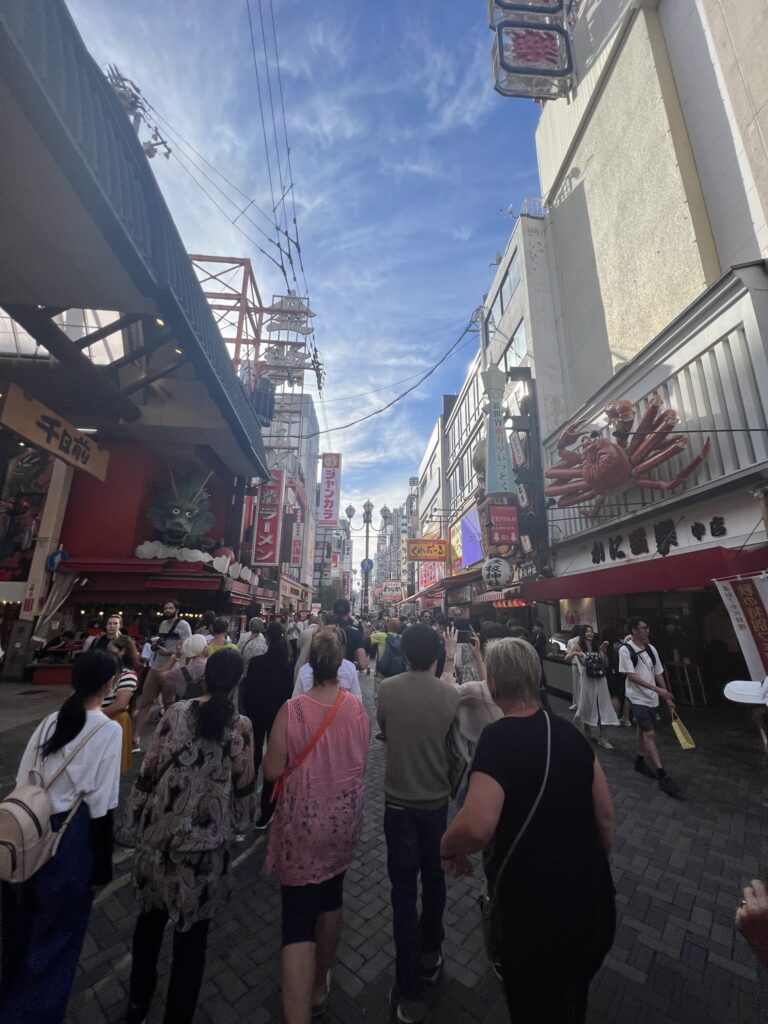
Is a backpack better than a suitcase for travel in Japan? For independent travel through Japan, yes, a backpack wins for most people. Japan’s stations are full of stairs, narrow gates, and crowded transfers where you walk far more than you expect, and many smaller ryokan and guesthouses have steps, tight entries, or no elevator. A backpack keeps your hands free and your luggage moving with you instead of against you.
Here’s the thing the comparison articles miss. The problem with wheels in Japan isn’t the wheels. It’s the gap between where the train drops you and where you actually sleep. You will walk that gap. Sometimes it’s five minutes through a polished underground concourse. Sometimes it’s fifteen minutes through a residential neighborhood to a guesthouse with a staircase and no lift, and your suitcase becomes a 20kg anchor you’re lifting step by step while a line of people waits behind you.
Southeast Asia is the same lesson in a different climate. Dirt lanes, broken pavement, curbs with no ramp, the occasional walk from where the bus actually stops to where the bus was supposed to stop. Wheels do not love any of that. A bag on your back reads the terrain for you.
There’s a real exception, and I won’t pretend otherwise. If your trip is mostly big-city hotels with elevators and you hate the feeling of weight on your back, a well-built carry-on roller is fine. But for a varied, independent trip that mixes cities, smaller towns, and the kind of places worth deferring a dream 25 years for, the backpack is the bag that doesn’t fight you. Worth it: a travel backpack. Skip: the hard-sided suitcase, unless your whole trip is elevator to elevator.
The Best Backpack for Travel: Osprey Farpoint / Farview 40L
In the rest of the article, we’ll be going over all the reasons why this backpack is better than the rest.
Take my word for it, it’s the gold standard for backpackers for a reason.
And even if you’re not a “backpacker” and just want to travel without a suitcase, the comfort and accessibility makes this the greatest backpack created for travelers.
For more details on why, keep reading. If not, here’s the link.
Amazon: Ossprey Farview 40L (Womens)
Amazon: Ossprey Farpoint 40L (Mens)
What Actually Matters in a Travel Backpack (and What’s Just Noise)
Gear brands sell features the way restaurants sell garnish. Most of it is there to justify the price tag. After living out of a bag that had almost none of it, here’s the short list that actually changes your day, and the long list you can ignore.
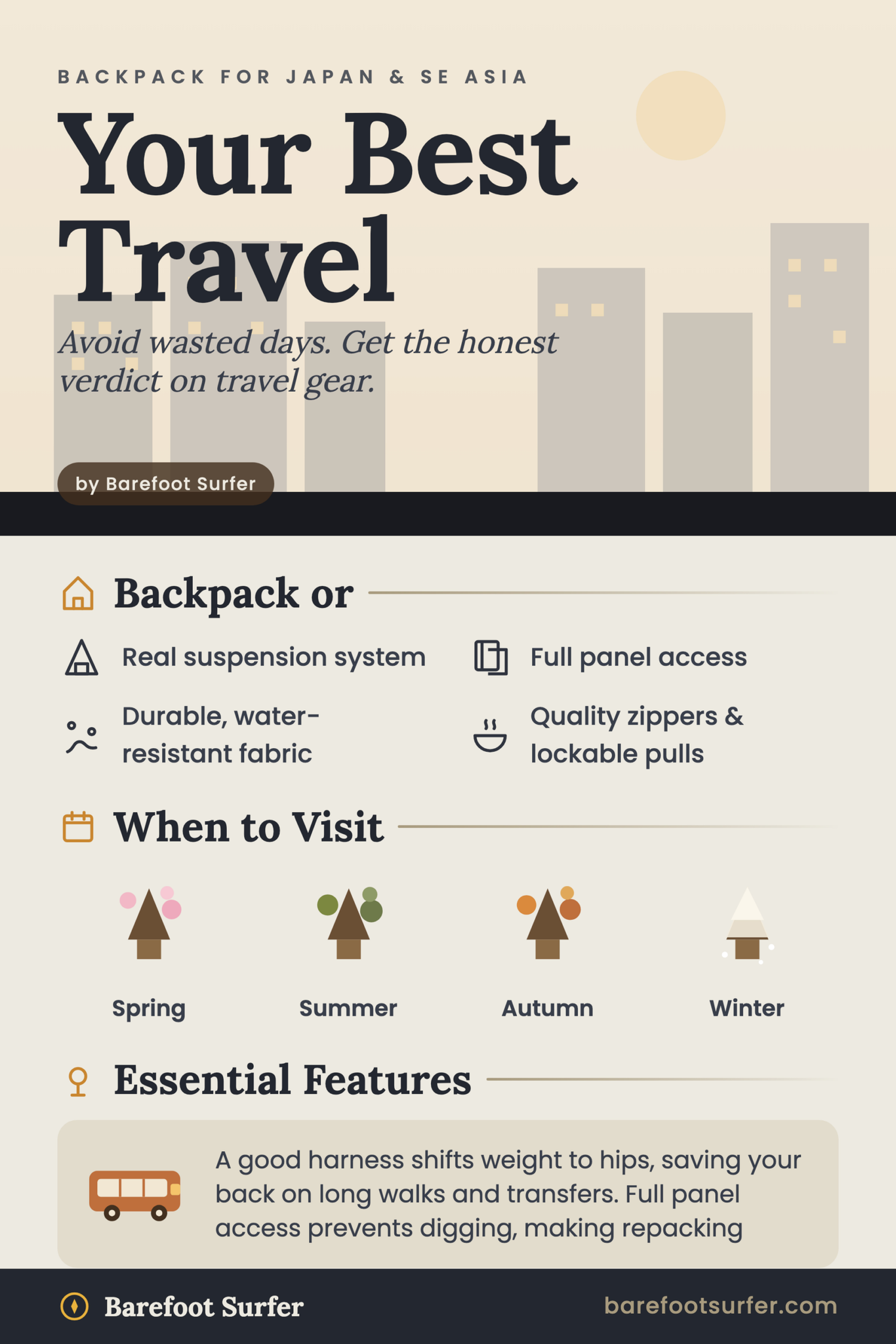
What features are essential for a good travel backpack? The non-negotiables are a real suspension system (padded shoulder straps, an adjustable harness, and a hip belt that transfers weight to your hips), full panel access so you can reach anything without unpacking, and durable, water-resistant fabric with solid zippers. Lockable zipper pulls, a stowable harness for check-in, and a breathable back panel are the genuinely useful extras. Everything else is noise.
The noise: flimsy detachable daypacks too thin to actually use, a dozen tiny organizer pockets you’ll forget exist, “expandable” capacity that just tempts you to overpack, and color-coded compression panels marketed like load-bearing engineering. None of that earns its weight.
Don’t Skimp on Comfort: The Harness That Saves Your Back (and Your Day)
Here’s the feature people skip, and I skipped it without meaning to.
For eight months I carried that thirty-year-old rock climbing pack with a basic hip belt and no modern support. It worked. I’m not going to pretend it didn’t. But “it worked” is doing a lot of lifting in that sentence. The weight hung off my shoulders and neck, and by the time I’d walked station to guesthouse I was quietly drained in a way that ate the back half of my day.
Years later, once I knew exactly what bad felt like on my own back, I started trying on the modern travel packs in shops and borrowing them off other travelers. The first time I put on a properly built one, with a real ventilated back panel and a hip belt designed to actually carry the load, it was night and day. The weight sat on my hips where my strongest muscles could hold it. My shoulders were just along for the ride. Same gear, completely different day.
That’s the whole point of a good harness. It’s not the straps on your shoulders, it’s the hip belt moving the load onto your hips, plus a torso length that fits you so the weight sits right. Cheap travel packs either skip the hip belt or slap on a thin nylon strap that does nothing, and you pay for it on the days you’re most tired and most far from your bed. Get the hip belt and the fit right, or every transit day taxes you.
Access Matters: How to Get What You Need Without Emptying Everything
There are two kinds of travel backpack: top-loaders and panel-loaders. For travel, you want a panel-loader (clamshell), the kind that unzips fully like a suitcase.
Top-loading hiking packs make you dig. Your charger is always at the bottom. A clamshell opens flat so you see everything at once and grab what you need. That sounds small until you’re in a six-person dorm at 6am trying to find one thing without dumping your entire life on the floor, or on a moving train repacking before your stop. Full panel access is the feature you’ll be grateful for daily. Top-loading is the one you’ll curse.
Materials and Build: What Holds Up in Japan’s Rain and SE Asia’s Humidity
Your bag will get wet. Plan for it.
Japan’s rain shows up fast and hard, and you won’t always be near cover. I learned this standing on the shoulder of a highway in Kyushu, hitchhiking toward Kumamoto, when the sky opened and the nearest shelter was the overhang outside a FamilyMart. Everything I owned was on my back. Southeast Asia is the slower version of the same problem: humidity that never fully lets anything dry, sudden downpours, and a constant low-grade dampness that finds its way into a cheap bag.
What actually matters in the fabric: a tightly woven nylon (sold as ripstop, often with a denier number, higher is tougher), a water-resistant coating, and quality zippers, which are the first thing to fail on a bad bag. No travel backpack is truly waterproof at the seams, so two cheap habits matter more than the fabric spec: carry a packable rain cover, and keep your electronics in a dry bag or zip pouch inside. That’s the part that saves your trip. A wet shirt dries. A drowned laptop ends a workday and sometimes a budget.
Hiking Pack vs Travel Pack: Why It Matters
What’s the difference between a hiking backpack and a travel backpack? A hiking pack top-loads, often rides on a tall internal or external frame, and is built around carrying outdoor gear into the backcountry. A travel backpack opens flat like a suitcase, has a stowable harness for airports, and is built for organization and city movement. For multi-country, mostly-urban travel, the travel backpack is almost always the better tool.
I say “almost always” because I lived the other version, a climbing pack pressed into travel duty. It survived, but it was the wrong shape for the job. If your trip mixes real walking days with city travel, a carry-on pack with some hiking DNA can be a smart middle ground, and I go deeper on that exact tradeoff in my guide to a carry-on hiking backpack for travel. For most of Claire’s kind of trip, though, panel access beats a summit-ready frame every time.
Carry-On Only: The Dream vs. The Reality for 10-16 Days
Carry-on only is a beautiful idea. For Japan and Southeast Asia, it’s also where most “just travel light” advice quietly lies to you, because it ignores the airlines you’ll actually fly.
Can I travel carry-on only for two weeks in Japan? Yes, two weeks in Japan carry-on only is very doable, since you’ll do laundry along the way and Japan’s convenience stores cover most gaps. The catch is the airlines, not the days. Carrying on saves you time and removes the risk of lost luggage, but every carrier on your route sets its own weight limit, and some are strict enough to force you to check at the gate.
Here’s the part nobody warns you about, and it’s the whole reason this section exists. The standard carry-on size is about 22 x 14 x 9 inches (56 x 40 x 23 cm), and a 40L pack fits that. Size isn’t the problem. Weight is. And the limits tighten the closer you get to the region:
- US long-haul carriers (Delta, United, etc.): generally enforce size, not a strict cabin weight on most economy fares. A 12kg bag is fine here.
- JAL and ANA, the Japan carriers: 10kg combined for carry-on plus personal item, and they weigh it at the gate. A 12kg setup is already over.
- Southeast Asia budget carriers (AirAsia and the rest): 7kg combined for cabin bag plus personal item, strictly enforced, weighed at the gate, and on the basic fare you often can’t even buy more cabin weight. A 12kg bag does not survive this counter without a plan.
That 7kg cap is the one that ends the carry-on dream for people who didn’t see it coming. You show up proud of your one bag, they put it on the scale, and now you’re paying a gate fee and checking it anyway. The fix is to keep your loaded bag genuinely light, pay up front for the airline’s heavier carry-on tier (AirAsia’s XTRA Carry-On raises it to 14kg), or accept that on those specific legs you’ll check the bag and build that into your day.
Here’s what I actually did, and I’m telling you because it’s true, not because it’s the advice a responsible person gives. I carried my 12kg pack onto 7kg budget flights all the time, on purpose, as a calculated gamble. The trick is that they almost always weigh your bag at the check-in counter, not the gate. So I’d check in online or at the airport machine and skip the counter entirely, which only works because I had no bag to drop and no reason to stand in that line. In my entire trip, I got weighed at the gate exactly once.
The agent points at my pack, then at the scale. I step out of line, pull on my jacket, tie a second one around my waist, and start loading the pockets with everything heavy I own. Charger brick, toiletries, power bank, the lot. I waddle back over looking like the Michelin Man. The bag clears the limit. I peel it all off the second I’m down the jetway and repack in my seat.
It works. But I’m a guy who travels light and treats a gate fee as the price of a bet I usually win. You’re planning a once-in-a-lifetime trip, not testing your luck against a luggage scale, so take one of the calm options above instead. Pay for the heavier tier up front, or keep the loaded bag genuinely light, and walk to the gate with nothing to prove. The jacket trick is real. It’s also a gamble, and your trip is not the place to learn you packed three kilos heavy.
What size travel backpack should I get for 10-16 days in Southeast Asia or Japan? For 10 to 16 days, a 40 to 45L travel backpack is the sweet spot, big enough for varied weather and a few souvenirs, small enough to carry comfortably and qualify as carry-on by size. Minimalists can drop to 35L; if you plan to shop or pack for cold and warm climates in one trip, lean toward 45L and watch your weight against airline caps. I lived out of 45L across every climate for eight months, so two weeks is very achievable.
And the honest nuance for a 10-to-16-day trip: pure ultra-minimalism has limits. You’re crossing climates and you might actually want to buy things, which is the whole point of going somewhere special. The move isn’t to suffer with 28L. It’s to carry a right-sized bag and pack it smart, which is the next section.
The Specific Backpacks I’d Trust (and Why They Earned It)
I’ll be straight about how I know what I know, because for this site that’s the whole game.
I did not tour Southeast Asia with a fancy modern pack. I toured it with the thirty-year-old climbing bag. What I did do, once I knew what good and bad felt like on my own spine, was try on every travel pack I could get my hands on. In shops across Osprey, Gregory, Deuter, Cotopaxi, Decathlon, Columbia, and North Face, and on the backs of travelers carrying Millet and Mammut. Loaded them up, walked around, paid attention. So this isn’t a spec sheet I copied. It’s the most comfortable bag I could find after carrying the worst one for eight months.
My Top Pick: The Osprey Farpoint 40 (or Fairview 40 for Women)
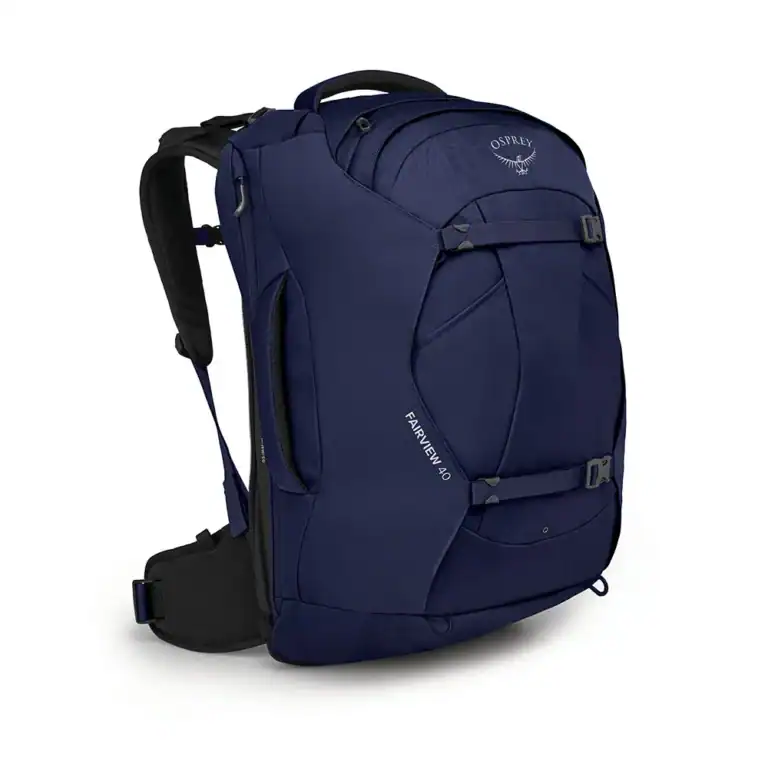
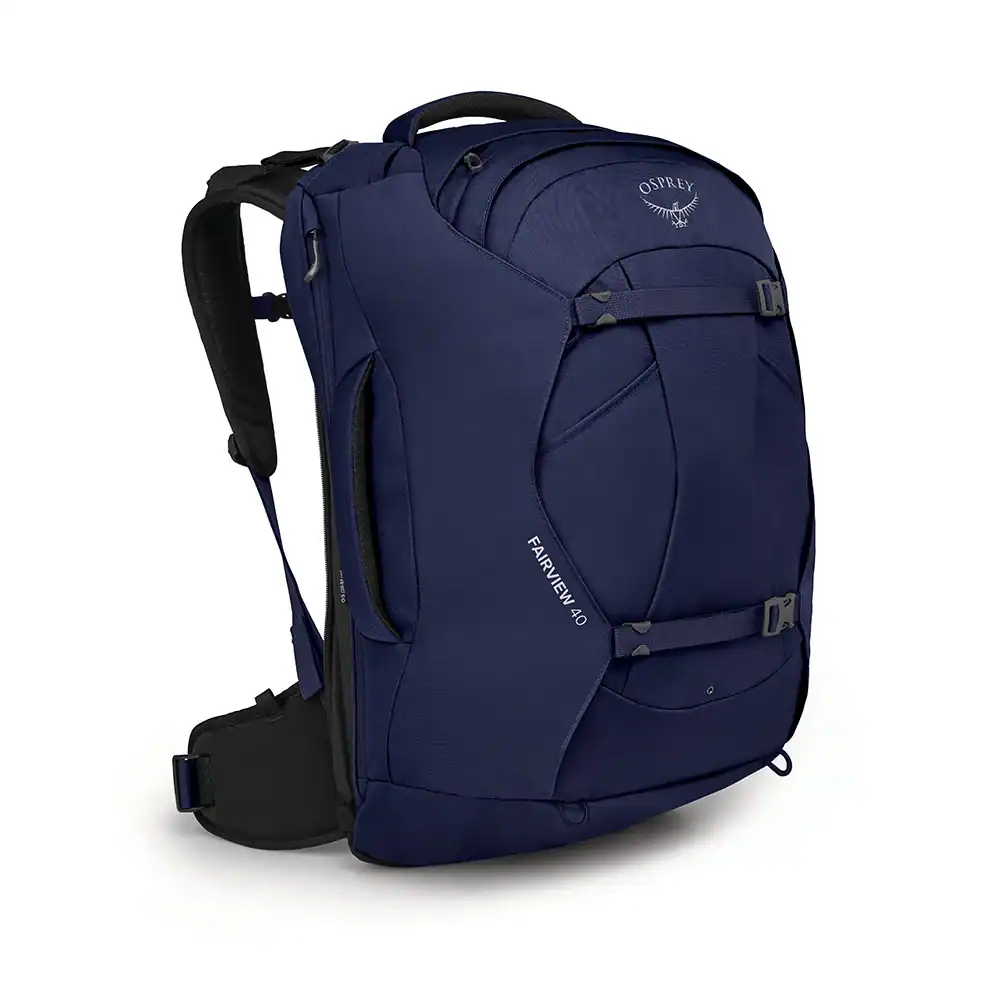
If I were buying today, it’s the Osprey Farpoint 40 for men, or the Fairview 40 for women. Around $200. It was the most comfortable of everything I tried on, and it wasn’t close.
Here’s the link.
Amazon: Ossprey Farview 40L (Womens)
Amazon: Ossprey Farpoint 40L (Mens)
Why it works for this kind of trip. It’s a clamshell, not a top-loader, so it opens flat like a suitcase and you grab what you need without digging. The AirScape back panel is that ridged, breathable mesh-and-foam support that vents against your back instead of turning into a sweat pad, and it pairs with a real load-bearing hip belt and an adjustable torso length. That combination is what makes weight disappear. The harness zips away behind a panel for check-in, so airline belts don’t shred your straps, and the main zippers lock. Carry-on sized by design, with a padded laptop sleeve.
Is it the perfect bag for disappearing into the mountains for a week? No, and it doesn’t pretend to be a technical hiking pack. But for city-style travel where you open and close zippers ten times a day and walk station to guesthouse, it’s built exactly right.
For Claire specifically, get the Fairview, not the Farpoint. It’s the women’s-specific fit, a shorter back length and straps shaped for a woman’s frame, with an extra-small option for anyone under about 5’4″. A hip belt only does its job if the bag actually fits your torso, and this is the version that will. That single fit detail is the difference between a hip belt that carries the load and one that just sits there.
One real weakness, and I’d rather tell you now. The main compartment is one big open space with almost no built-in organization. Not a dealbreaker, it’s a packing-cube problem, and I solve it in the next section.
If you splurge on one thing for this trip, make it the bag. Everything else you can fix on the road. A bag that fits you, you forget about. A bag that fights you, you carry every single day.
Close Runners-Up: When Another Option Makes More Sense
Two honest alternatives.
Want more room or a built-in daypack? The Osprey Farpoint 55 / Fairview 55. Same comfort, but it’s a 40L main pack with a detachable day pack of around 15L that zips off for excursions. The main pack still works as a carry-on, the day pack rides separate. If you’re torn between packing light and wanting a small bag for a day out in Kanazawa or a temple town, this is the answer.
If the Osprey doesn’t fit your back, look at Gregory or Deuter. They were the closest to the Osprey when I tried them on, both serious brands with real suspension systems. Fit is personal. The only way to know is to put weight in a bag and walk around the shop, so go try it on loaded if you possibly can. The bag that fits you beats the bag that reviews best.
Practical Packing Strategies for Your New Backpack
The bag is half the system. Packing it is the other half, and it’s where you reclaim the comfort and access we just paid for. It’s also the fix for that one big open Osprey compartment.
Packing cubes are the single highest-return move. They turn a backpack into a set of labeled drawers, so a clamshell bag actually behaves like one. One cube for tops, one for bottoms, one for underwear and socks. You pull the cube, not the whole bag. In a shared dorm or a tiny ryokan room, that’s the difference between staying organized and living out of a pile on the floor.
A few more that earn their place:
- Roll, don’t fold soft items. Less wrinkling, more space, easier to wedge into corners.
- Heaviest items against your back, centered. Weight high and close to your spine carries far better than weight sagging low and away from you. This is half of what makes a bag feel comfortable.
- One small dry pouch for electronics, as mentioned. Non-negotiable in this part of the world.
- Leave 15 to 20 percent empty, especially if you’re even slightly tempted to buy anything. A bag stuffed to the zippers on day one has nowhere to put the thing you fall in love with in a Kanazawa craft shop.
- A packable tote or thin secondary bag weighs almost nothing and saves you when you want a daypack for a city or a way to carry the overflow on a travel day.
I’ve got the full clothing-and-gear breakdown, what I actually packed and what I’d cut, in my backpacking packing guide. And since the only other piece of gear that wrecks a day as fast as the wrong bag is the wrong shoes, what to put on your feet for this region is worth thirty seconds before you book anything.
The Verdict
For an independent, varied trip through Japan and Southeast Asia, the call is simple. A well-chosen travel backpack, 40 to 45L, clamshell-opening, with a real hip belt, is worth every dollar. Not a hiking pack, which top-loads and is built for a different job. Not a hard suitcase, which fights you the moment you leave the elevator. Get the bag right once and it disappears, which frees your irreplaceable days for Japan instead of for your luggage.
If you upgrade one piece of gear before you go, make it this one. I learned that the slow way, with a thirty-year-old pack and a lot of sore shoulders, so you don’t have to.